On Great Eats

January 31, 2015

February 1, 2015

FOOD has been defined as anything eaten to satisfy an appetite and to meet needs for growth.  It also maintains all body processes, and supplies energy to maintain body temperature and activity.  So food is important.  But the question that arises is – where is the food consumed?  At home?  In a restaurant?  This article is about the latter.

Anything on the history of food?  For nearly 100% of human history, human beings were hunters and gatherers of food.  The variety of food they consumed had the potential to provide essential nutrients, but the quantity varied, thus limiting the number of people that could be supported in a given area.

The first major event in terms of increasing food supply was the agricultural revolution, which occurred approximately 10,000 years ago.  This revolution resulted in an increase in both the quantity and dependability of the food supply.  The Industrial Revolution that began about 400 years ago also had explosive effects.   The application of scientific knowledge to food production resulted in many opportunities to increase food output, which brings us to recent times.

A fond memory of childhood (during the late 1930s) was dining with my parents on special occasions at a fantastic Greek restaurant called The Acropolis located in the vicinity of Columbus Circle.  Today, we often frequent another Greek restaurant in Bayside by the name of The Gyro Corner.  Although the atmosphere is good and the price is ridiculously low, it is the food that brings us there.  This place is a must for those who enjoy simple Greek food.

But it is now 2015 and we need to talk about restaurants in and around East Williston, home of yours truly.  Why?  I’ve been relegated to a relatively sedentary life that is highlighted by watching basketball games, betting on horses, visiting Florida, writing technical books, writing The Theodore Newsletter (www.theodorenewsletter.com) and EATING.  What follows are recommendations for a host of restaurants in the categories of (in alphabetical order): breakfast, Chinese, delicatessens, diners, fast food, Greek, hamburgers, and Italian.

Before proceeding, I need to note my position on spending money in Williston Park.  I’ve both stopped shopping there or donating to any of their causes after receiving a Village revenue-enhanced parking ticket geared to gouge an unsuspecting visitor.  When there were two locations for a particular restaurant and one was located in Williston Park, I listed the other address.  I also chose not to comment on French and other high priced restaurants.  “Exotic” restaurants – which I never frequent – were also not reviewed.

BREAKFAST

IHOP (Williston Park):  Senior citizen specials are excellent.  Reasonably priced.  Parking is a major problem of gigantic proportions and expect to wait for a table.

McDonalds (Mineola):  Mary and I are regulars.  Two sandwiches plus unlimited coffee (that is excellent) for a whopping $4.76.  Coupons can also help.

Denny’s (Carle Place):  Second to IHOP.  Very kid-friendly.

Starbucks (Carle Place):  Mary’s favorite for coffee.  Not for me; I think people who patronize Starbucks are nuts.

Dunkin Donuts:  My favorite coffee but not my place for breakfast.

CHINESE

Jade King (Roslyn Heights):  The standard by which others are gauged.  Excellent food at unreasonable prices.  Try some of the locals instead.

DELICATESSENS

DaVinci’s (Albertson):  Fair by me.  Absolutely my family’s favorite.  Check for specials and coupons.  Excellent sandwiches.  Decent Italian dishes.

Cirello’s (Williston Park):  DaVinci’s competitor.  Check for $5 coupons.

North Shore Farms (Mineola):  The place I usually go to.  A decent mixture of good Greek food, Italian food, cuts, soups and bread.  Ah, the bread.

Harry’s — formerly Rudy’s (Williston Park):  Harry’s Greek food is excellent – as good as it gets.  Breakfast specials are also good.

DINERS

The Lantern (West Hempstead):  Our favorite at one time.  Has fallen upon hard times of late.

Williston Town House (Williston Park):  One of the better ones.  Lots of food at reasonable prices.  Excellent for breakfast.

Old Westbury (Old Westbury):  An upscale version of the Williston Town House.

Excellent ambiance.  Some nice Greek dishes.  You can’t go wrong here.


FAST FOOD

McDonalds (Mineola):  Bring your coupons and you’ll get a decent meal at a very reasonable price.

Burger King (anywhere):  No thanks.

Wendy’s (Greenvale):  My favorite.  Bring your coupons and get treated to an excellent meal at a reasonable price – even more reasonable than McDonalds.

Nathan’s Famous (New Hyde Park):  Only with coupons.  Hotdogs, sauerkraut, mustard and fries are excellent.

GREEK

OPA Grille (Williston Park):  The best of the locals but overpriced.

The Gyro Corner (Bayside):  I had to mention this place again.  Nothing compares to it.  Best value.  Excellent meals.  Try the gyro dinner ($9.85) with the lemon potatoes and you’ll take food home.

HAMBURGERS


TR’s Great American Restaurant (Williston Park):  Reasonably priced.   The favorite of many, but not mine.

McDonalds (Mineola):  You can’t go wrong.  Ah, their French fries.

Wendy’s (Greenvale):  My favorite.

The Shake Shack (Carle Place):  The family’s favorite.  Slightly overpriced.

Burger King (anywhere):  Not for me.

ICE CREAM

Hildebrandt’s (Williston Park):  One of our family’s favorites, but I’ve never had ice cream there.

Carvel (Roslyn Heights):  The standard by which all others are judged.  Excellent stuff.  A bit pricey.  Good service.

Baskin Robbins (Albertson):  No thanks.  Fair service.

Breyers (any supermarket):  The best by my standards.

ITALIAN

Vincent’s Pizzeria & Restaurant (Albertson):  Absolutely the best pizza anywhere; no other pizza compares to theirs.  Pricier than others but well worth it.  I’m not a fan of their restaurant.

Vincent’s Clam Bar (Carle Place):  Consistently voted the best restaurant.  Excellent salads, main course and desert.  Reasonably priced.  Excellent $10 luncheon.  However, it is much too noisy.

Umberto Pizzeria & Restaurant (New Hyde Park):  Perhaps the best.  Prices reasonable.  Pizza good.  The chicken rollatini is to die for.

Angelina’s (Williston Park):  Great local restaurant.  Kid-friendly, reasonably priced.  Absolutely the best Caesar’s salad and Bolognese.

LaParma Restaurant (Williston Park):  The family’s favorite, but not mine.  Grossly overpriced—grossly.  Food loaded with garlic.

Da-Angelo – Pizzeria and Restaurant (Albertson):  One of my favorites.  A local gem.  Very reasonably priced.  Super dinner specials on Monday-Wednesday.  Kid-friendly but noisy.


Lou Theodore

NEXT POSTINGS:  (tentative)

MARCH 1:                 On the SATS

APRIL 1:                    On Paying Student – Athletes III

MAY 1:                       On School Taxes


On Football Boxes

December 31, 2014

Traditional gambling generally refers to the wagering of money on a yet-to-be determined event or outcome that may be dependent on either chance or skill, or both chance and skill. Casino roulette is a game of chance, while poker is a game of skill. Gambling on athletic sporting events, such as football, basketball, baseball, etc., is generally viewed as involving both skill and chance. And, gambling has been around a long, long time.

Gambling has been practiced by humans throughout history. As humans slowly developed and acquired knowledge of the nature of their environment, the attitudes toward and the nature of gambling changed. Today, gambling occurs throughout the entire world. This gambling can take on a variety of sporting forms, including both thoroughbred and dog races along with events such as football, basketball and baseball. Other forms, including Lotto, dice, slot machines, etc., are also prevalent; the former is regularly used by politicians as a means of generating “tax” revenues.

Why the above discussion? It’s professional football, i.e., the National Football League (NFL), playoff time. And that means that billions of dollars will soon be wagered on not only the Super Bowl (the championship game) but also all the playoff games leading to the Super Bowl.

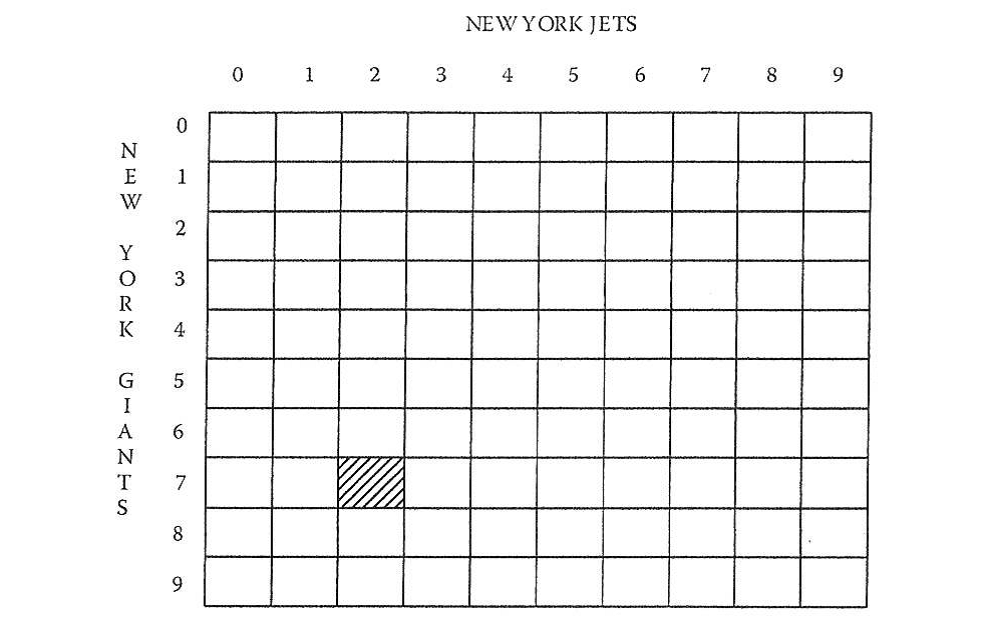
One of the major gambling options during this period is to “buy a box” in a uniquely arranged square, usually referred to as the pool. An example of a pool is shown in Figure 1 for a Giant-Jet game. As can be seen, there are 100 boxes. If each box costs $1,000, the total cash pool is $100,000. The individual, who correctly selects the box with the last digit of the final score for each team takes home the bacon, i.e., wins the $100,000. If the final score is Jets 22/Giants 7, the owner of the shaded box is the winner. Scores such as Jets 12/Giants 27 or Jets 22/Giants 37 would also serve as winners for that box.

nonrandom pool
FIGURE 1 Nonrandom pool.
However, employing the format in Figure l does not provide each person buying a box an equal chance of winning. Knowledgeable football fans would immediately realize that the best numbers to select are 0 and 7, whereas the worst are 2, 5, and 6; therefore, the arrangement of the box as in Figure 1 does not provide each bettor with an equal chance to win. This bias can be removed, and the bet reduced to one solely of chance by assigning the numbers to each team in a random manner after individuals have paid and selected a box. The procedure most often used is to write numbers from 0 to 9 (each) on a piece of paper. The 10 pieces of paper are then randomly drawn from a container and sequentially placed along the side of the square – first horizontally and then vertically. The result might look like Figure 2. Had the same box been selected (see Figure 2), the bettor’s last team digits would be Giants 2/Jets 0. A final score of Giants 42/Jets 30 would be a winner as would Giants 12/Jets 20.
random pool
FIGURE 2 Random pool.

Many gambling activities are available and legal in the U.S. However, the above form of gambling is not legal although it is practiced in private clubs, bars, parties and homes. For example, the football boxes have become an integral part of an annual party that I host at our home for the Killeen’s Tavern basketball team of yesteryear. One of the keys in this betting venture is to ensure that the individual running the box activity does it in a manner that is fair and that the odds are not heavily weighted in favor of the “concessionaire.” Generally, 5 to 10% of the total pool is considered reasonable compensation or takeout for running this illegal business/gambling activity. For whatever it’s worth, there is no takeout at our party, i.e., all of the money is returned to the winners.

The topic of March Madness invariably arises in any discussion of this form of gambling. The NCAA Men’s Division 1 Basketball Championship, or March Madness, is a single-elimination tournament – known as the Big Dance – held each spring and features 68 college basketball teams battling to determine the national championship. The box activity has recently worked its way into this sports venue. And, believe this or not, but the box activity is also part of the gambling that takes place with the World Series. Once again, it is the last digit of the final score of the game. Thus, the key box numbers for a winning final score of 11-3 are 1, 3.

Good luck to those of you who participate in the football box pool this month and beyond.

It’s also that time of the year. Merry Christmas, Happy Holidays, and Happy New Year to the newsletter readers.

Lou Theodore

NEXT POSTINGS: (tentative)

FEBRUARY 1: On Great Eats
MARCH 1: On the SATS
APRIL 1: On Paying Student – Athletes III
MAY 1: On School Taxes


Hofstra Men’s Basketball: There is Hope on the Horizon

November 30, 2014

December 1, 2014
One of my articles last December was entitled: “Hofstra Men’s Basketball: Is There Hope on the Horizon?” Well, December has arrived and that can only mean one thing: it’s time for Hofstra Men’s Basketball. And this year, the title is “There is Hope on the Horizon.”

Gone is Hofstra’s lifetime superstar Charles Jenkins. Gone are Mike Moore and shot blocker Greg Washington. What’s left? Let’s find out about the present squad.

First, and perhaps foremost, is the 2nd year coach, Joe Mihalich who I ranked in my upcoming book, “Basketball Coaching 101” as the 2nd best coach in the county. (However, my colleagues claim that the statement is based on the fact that Mihalich is the only coach who talks to me.) And who is Joe Mihalich? Credit is due to Hofstra’s outstanding Athletic Director Jeff Hathaway who somehow managed to convince Mihalich to leave Niagara University and resettle at Hofstra. Hofstra now has a Men’s Basketball roster comprised of student-athletes who under Mihalich’s direction, have been as equally focused on their schoolwork as on Mihalich’s playbook, and managing to stay out of trouble. So in a very real sense, Hathaway will deserve credit if and when there is a turnaround in the basketball program.

Second, are the players. There are, relatively speaking, massive changes here. The returnees include Dion Nesmith (who was shockingly granted an additional year of eligibility), Jamail Robinson – who I predict will be a big surprise this year, and Moussa Kone – who may have difficulty getting playing time at center. The new additions are the wild card. Included here are transfers Juan’ya Green and Ameen Tanksley–transfers from Niagara, SMU transfer Brian Bernardi, redshirt freshman guard Eliel Gonzalez, Rokas Gustys from Oak Hill Academy, transfer Malik Nichols, and freshman center Andre Walker. This is truly a quality group.

The third factor is the Conference itself, the CAA (Colonial Athletic Association). The quality of both the conference and players have been decreased with power teams transferring out of the Conference and player graduation. It boils down to this: Hofstra is loaded and has a reasonable chance to win the tournament championship and (yes!) move on to the NCAA Tournament.

There is a fourth factor. I believe that the route to basketball championships is through the backcourt. Hofstra definitely will have the best backcourt in the CAA with Jaran’ya Green and Dion Nesmith. These two could probably start for many teams in the country. If the “bigs” can hold their own, my NCAA prediction will very likely become a reality. And don’t forget my sleeper Jamail Robinson.

But there’s more on the fourth factor. As noted, it is the backcourt that usually determines the level of success of a team. But most importantly is the defensive capability of the backcourt. How important is defense? Here is a case and point. Stevie Mejia served as the point (or I) guard for the 2012-13 Hofstra team. Colleagues in press row commented on several occasions that Stevie wasn’t playing at his full potential. What they were referring to was his scoring. Yet, during the season, Stevie stopped the star guards Scott Machado and Michael Alvarado of Iona and Manhattan College, respectively, Cold!, and each were projected first round and second round picks, respectively. I am sure there have been better defensive guards, but he is the best little guard I have ever seen. Furthermore, Hofstra lost three games during the 2013-14 season because of an inability to stop the star guard of the opposing team.

The reality is that defense doesn’t get the credit it deserves in the roll it can play in determining the outcome of a game. The reader should never forget that defense is 50% of the game. DEFENSE IS AS IMPORTANT AS OFFENSE. You can never lose a game if your five starters have the capabilities of shutting down their opponents. However, you can lose a game even if your five starters have the capability of scoring at will.

So, what’s the bottom line? There is indeed hope on the horizon this season despite the 10 wins record last year. The sun will not be setting on the horizon…it will be rising as the strangers on the squad get better acquainted and the freshmen centers mature. I believe that this is going to be an exciting year that may (and hopefully) extend deep into March. Only time will tell whether the hope is real or whether it is just another adjustment year.

Finally, folks do yourselves a favor and consider attending one of the games. Attending Hofstra games still remains the best sports buy in the New York Metropolitan area; it’s even cheaper than going to the movies. There is ample free parking, easy access in and out of the Sports Complex, the concession stands are not a rip-off ($3.25 for a dog, $1.50 for a soda, etc.), and there isn’t a bad seat in the house. Did I mention that its $5 for seniors and children, and the whole exciting atmosphere is conducive to family attendance? I suggest sharing it with someone you care about. I guarantee you won’t regret it.

Note: The above article was written in early November. The team’s record at the time of posting this article (November 28) was 3-2.

Lou Theodore

NEXT POSTINGS: (tentative)

JANUARY 1: On Football Boxes
FEBRUARY 1: On Great Eats
MARCH 1: On the Sats
APRIL 1: On Paying Student Athletes III
MAY 1: On School Taxes


On Paying Student-Athletes II

November 3, 2014

November 1, 2014
The author penned an “As I See It” article titled “On Student-Athletes” near the turn of the century. This was followed by the author’s “As I See It” article nearly 10 years ago titled “On Paying Student-Athletes”. This article is a follow-up to these two papers.

As noted earlier, it is important for the reader to understand that college sports is no longer a sport in the traditional Hellenic sense. It is, pure and simple, a big business that is in the business of providing entertainment in order to make money. Sports is no longer a term that applies at the professional level and most major collegiate programs. Sports has become big business and capitulated to excesses with the corruption that often accompanies uncontrolled capitalism. Bottom line: it has been converted to entertainment. A small group of individuals provide the entertainment and, contrary to American democratic principles and capitalism, are essentially deprived of fair compensation. Most of these entertainers get little to nothing in terms of monetary salaries. A handful are later provided significant financial rewards; it is almost strictly a matter if the entertainers make the pros. In basketball, first round draft choices are guaranteed a millions dollars a year for three years. Second round draft choices get nothing unless they make the team.

Some simplistic individuals continue to view sports and/or athletic events in the classic tradition of the Olympics. It was 500 BC when a handful of Spartan warriors routed the invading Persians at the Plains of Marathon, located approximately 25 miles from Athens. Immediately following the victory, the Olympics were born. The Olympics continued to flourish as a “pure” sport until politics, and more recently, money was introduced into the mix.

Make no mistake about it, the sole purpose of colleges and universities in the old days was to provide quality education. In recent years, these institutions of higher learning have moved into the business of making money. I speak from firsthand personal experience.

And what do we have today? Professional sports are run by the owners, commissioners, and networks in a manner that provides the best in entertainment in order to maximize its profits. Even the officiating is geared toward this end. (Fortunately, the athletes at the professional level have become rich, being appropriately compensated).

Here is what James Michener (my favorite author) had to say in 1990:

“It is still reprehensible for colleges to glean huge profits from their football and basketball teams, while giving their student players no share. I believe that, before the next century, colleges will pay their athletes, and I recommend a system in which a high school graduate who is awarded a scholarship will be allowed 10 years in which to use it. This will enable him to move into the pros while still young and useful, yet obtain his college degree when he is waived out of the league.”

I would go significantly beyond Michener’s position. These athletes, most of whom are anything but students, should be paid. They need representation, just like professional athletes, if they are to receive their fair share. Otherwise, their coaches and individuals like Myles Brand of the National Collegiate Athletic Association (NCAA) will continue to deny them endorsements, gate receipts, TV contracts, etc., on the grounds that such “remuneration will corrupt sports and the amateur ideal.”

One can only wonder if student-athletes (SAs) give thought to what they have given to society. One can only wonder if the NCAA has ever given thought to the SAs role in society. The author believes the suits at the NCAA rarely give thought to the aspirations and the future of the Unsuccessful SAs who would more appropriately be referred to as USAs.

Even after high school, the main problem with many of the SAs is that no one has taught them how to be a star in college. There is television, radio, crowds, press conferences, interviews, etc. Some of these activities are often embarrassing. The main problem with the successful SAs (in this case that means reaching the pros) is that no one, once again, has taught them how to be a star. But what about those SAs who are unsuccessful, i.e., USAs. Once the (senior) season is over, the artificial stage of their college life has ended, and the USAs glamorous world is gone. Kaput! An irreversible happening that will never return.

What happens then? The USA returns to the real world…his home, his city, and in some cases, his country. He is effectively alone within a day. Some do return to their institution and keep in touch with their teammates, and occasionally their coaches, but the contact is inevitably limited. The ending comes quickly as earlier social and professional contacts decrease at an exponential rate.

The former intimacy with both players and coaches dissolves as the USA retreats into another world and is once again simply part of the masses. No longer is everything taken care of by other people; the servants who prepare his meals, outfit him, and provide travel arrangements are now history. And even worse, no one has forewarned him, and no one has taught him to adjust to a new lifestyle.

On March 25th (Greek Independence Day) 2014, a regional National Labor Relations Board (NLRB) ruled that Northwestern University football players are entitled to unionize. Even though authorities appear to be in agreement that this decision will almost certainly be upheld by the national (full) NLRB, lines have been drawn and the NCAA is certain to litigate the decision. This decision could significantly impact the whole spectrum of labor law – including minimum wage, health benefits, social security provisions, unemployment insurance, etc. If upheld, as expected, this decision will (not could) bring the long awaited and justified demise of part – if not all – of the NCAA. I believe that the NCAA will be so crippled by changes that the NCAA, as it is known today, will either disappear or take on a completely different role in college athletics in the future.

There is so much money involved that the sport of college basketball and football will survive. The above court decision will no doubt lead to salaries plus benefits for the athletes, many of whom will no longer be viewed as students. In effect, the term student-athlete will disappear from the dictionary. How, where, and why revenues will be distributed to college athletes – many of whom will be categorized as employees – will be determined by business decisions in the relatively near future.

A colleague and former adversary (on the basketball court) Neal Gillen, a Washington, D.C. based attorney, offered the following “solution” to the SA problem for my soon-to-be-published book titled “Basketball Coaching 101”:

“The issue must be addressed on three separate fronts:
A. An enforceable contract between the school and the student-athlete
B. Changing NCAA eligibility rules
C. Professional leagues agreeing not to sign collegiate players until they or their class have graduated
I have also included provisions for player travel expenses and a monthly stipend to be determined. I did not include a provision for a student athlete to participate in the proceeds of the sale of jerseys, T-shirts, or other memorabilia, but were I to do so, any such payment would not be forthcoming until the athlete or his or her class has graduated. There could be antitrust issues, but should the changes I propose be made and upheld, the game would change once more for the better.

A. Contract between Student Athlete and Educational Institution
The student athlete agrees that in consideration for he or she receiving from the academic institution a four year scholarship that includes tuition, books, tutoring, room, meal, laundry, cleaning, and reasonable travel expenses to and from home at the beginning and ending of each semester, in addition to a monthly stipend during his or her athletic and academic eligibility, said stipend to be determined pursuant to a national agreement between this and other academic institutions and the NCAA, that said student will strictly adhere to the rules and regulations of this academic institution and its athletic department, endeavor to maintain good study habits, participate in all scheduled classes unless otherwise excused because of ill health or playing commitment, will make up any such classes missed, complete all research papers assigned submitting only original research conducted by him or herself, will comport him or herself in a proper moral manner at all times and will refrain from drinking alcoholic beverages, smoking, using narcotics, gambling or providing information about the team’s or a player’s status to known gamblers. Said athlete also agrees that he or she is contractually bound to this agreement, and a breach thereof will require that liquidated damages be paid to the education institution should the player fail to complete the 4-year commitment. Said damages to be determined by arbitration conducted pursuant to the rules of the American Arbitration Association.

B. NCAA Athlete Participation Standards
Effective on a certain date, student athletes in all NCAA Divisions shall be ineligible to participate in varsity sports until their sophomore year, provided they have achieved a minimum 2.5 cumulative average and have successfully completed course work in 32 credit hours. (Author’s comment: This Provision could go a long way toward reducing or eliminating the NCAA academic abuses)

C. United States Professional Athletic Leagues and/or Associations
Players shall not be eligible to contract signatories obligating them to play the professional sport overseen by the governing league and/or association to which a team is a member of and is governed by until his or her college class has graduated unless prior to that date the player in question has earned the necessary credit hours to graduate.”

It all boils down to this: As a former professor, I was paid for chemical engineering education services that were provided to an institution that made money because of the services provided. A SA is not paid for services that are provided to an institution that makes money because of the services the SA provides. Why was I paid and the SA not paid? Isn’t this country a democracy that operates with an economic system based on capitalism? The NCAA apparently does not believe that James Madison’s Constitution applies equally to all – only to some of us.

Folks, Hamlet was right. Something is rotten, terribly rotten.

Perhaps Alex Karras, Detroit Lions defensive end said it best about his scholastic days: “I never graduated from Iowa. I was there for only two terms – Truman’s and Eisenhower’s.”

Lou Theodore

NEXT POSTINGS: (tentative)

DECEMBER 1: On Hofstra Men’s Basketball: 2014-15 Season
JANUARY 1: On Football Boxes
FEBRUARY 1: On Great Eats


Barack Hussein Obama Update IV

October 1, 2014

October 1, 2014

It’s time for another BHO article. As many in the reading audience know, I have repeatedly claimed (and believe could prove in a court of law) that BHO is

1. a liar
2. dumb
3. lazy
4. corrupt
5. un-American
6. an egomaniac
7. nasty and arrogant

I’ve listed three dozen of BHO’s activities since the last article in the April 2014 newsletter. Once again, the reader is encouraged to assign the appropriate number above to each activity.

1. Continues to tell the public that he is beholden to no one, including you and me.
2. Has become a habitual loafer.
3. Played golf and had a jolly old time immediately following a ISIS beheading incident.
4. Continues to wage class warfare between the rich and poor, young and old, sick and healthy, white and black, educated and uneducated, etc.
5. Regularly is without and/or lacking a plan, purpose, policy, preparation, etc.
6. Responses to critical issues have been laughable.
7. Continues to place our nation deeper into debt.
8. He is not a student of geography, a characteristic of dumb people.
9. He is not a student of history, a characteristic of dumb people.
10. Has attempted to rewrite the history of our nation.
11. Continues to impose repressive legislation and rules that has hampered the development of business.
12. Continues to refuse to accept the greatness of this nation.
13. He is a coward who has refused to accept that war, i.e., the necessity of war, is sometimes necessary and inevitable. Hello Neville Chamberlain.
14. Has poisoned part of our nation with his disloyalty.
15. Refused to accept that there is an international terrorist threat.
16. Improperly decided to take action on one shooting in Ferguson for which he had no facts.
17. Has refused to take action on the documented, round-the-clock murder of hundreds of young blacks in Chicago, yet got involved with the killing of a young black in Ferguson, MO.
18.
19. Stood by quietly as fellow-racist Eric Holder expressed sympathy and understanding for those rioting, shooting and looting in Ferguson.
20. Refuses to hold his appointees responsible for any wrongdoings.
21. Continues to use the government for political and personal purposes.
22. Refuses to accept that duties supersede all personal and ideological considerations.
23. Has never commented on his failure to honor the promise to “get to the bottom of this problem….” 8 TIMES. 8 TIMES!!!
24. Has refused to sympathize with whistle-blowers.
25. Has effectively claimed (with a straight face) that he knew nothing about the IRS, Benghazi, Fast and Furious, etc.
26. Never explained what happened with his “red line.”
27. Never retracted his initial Benghazi statement that it “was a spontaneous riot about a movie.”
28. Never retracted his promises on Obamacare, i.e., premiums will be lowered, you can keep your doctor, it will be a simple process, etc.
29. Is more concerned about healthcare for terrorists, prisoners, illegals, and those unwilling to work than for our veterans.
30. Has never really explained his failed foreign policy with respect to ISIS, immigration, Putin, North Korea, China’s excursions, al Qaeda, veteran services, etc.
31. Continues to change things in our government.
32. Has forgotten this statement: “I, Barack Hussein Obama, pledge to preserve, protect and defend the Constitution of the United States of America…so help me God.”
33. He has successfully divided our nation and united our enemies.
34. Due to BHO’s position on foreign policy, energy, jobs, health care, etc., our nation is indeed in decline.
35. BHO is now into fundraisers and golf – wisely no longer lecturing us on his great accomplishment. Remember his dozens of speeches on Obamacare?
36. BHO blew it in Iraq (another idiotic decision) since the war was won and the country was well on its way toward a democracy – something that would have devastated our enemies in the Middle East.
37. Claimed to Bill O’Reilly that “there isn’t a smidgen of evidence that the IRS acted improperly,” even through his appointee Lois Lerner refused to testify.

I need to further address the events that have transpired in Ferguson. The rioting, looting and unlawful conduct following the shooting of the black man lasted two weeks. At no time did BHO and/or Eric Holder condemn this behavior by these criminals/misguided individuals. Why no comment from these two? It’s simple – both are racists. Why no condemnation by the liberal media? It’s simple — they are all corrupt and a disgrace to their profession.

Of course, there is still “I will put an end to conduct that breeds division, conflict, and cynicism”, “will bridge the gap between black and white”, “will have the most transparent administration in history”, and “will restore trust in Government.”

At this point in time, our nation is ruled by a lawless administration headed by a corrupt, lazy, lying un-American, and potentially crazed individual that has refused to be accountable to the electorate. The pressure and criticism the president is experiencing is justifiable but his ego is coming to the forefront, which may lead to disastrous results in the future. I say this because I believe our country is being run by an irresponsible uncontrollable committee consisting of really dumb people.

I will return next year with BHO V. I dread to think what else can transpire in the coming months with the idiot at the helm. Note: Some would argue that it is inappropriate and improper to call our President dumb and an idiot but remember this is the same guy who kept telling the world that he claimed he knew more than his speech writers, advisers, experts, etc., and is “focused like a laser on creating jobs.”

Lou Theodore

NEXT POSTINGS: (tentative)

NOVEMBER 1: On Paying Student-Athletes II
DECEMBER 1: On Hofstra Men’s Basketball: 2014-15 Season
JANUARY 1: On Football Boxes
FEBRUARY 1: On Great Eats


On Purely Chaste, Pristine and Random Thoughts XXI

August 31, 2014

September 1, 2014

It’s hard to believe, but I’ve lost track of what is the actual issue of this “On Purely Chast, Pristine and Random Thoughts” article. It may be the XXth issue, but then again, it might be the XXI; I’m settled on XXI. Here are 25 Thoughts:

* Flying has become a chore. My recent return flight from Long Beach, CA took 11 hours – not including a 1-hour wait for baggage.
* Currently writing my 102nd book entitled “Basketball Coaching 101.” Anyone interested in contributing can contact me at loutheodore1@verizon.net; I’m looking for individuals who know something about the game.
* This will be my 59th straight year of visiting Saratoga for the racing meet. It has become a bad habit and we now limit the trip to an Albany stopover.
* My most recent book was concerned with the need to develop a meaningful national energy policy; (see August Newsletter article) the book was dedicated to Governor Mike Huckabee.
* This is a true story. It took me nearly 3 days to complete and submit my taxes. Guess what? Last month, New York State requested I submit payment for the taxes owed. Since I have a cancelled check that the NYS cashed, I called to complain, but it is impossible to get through to them.
* Sometime back, Barack Hussein Obama (BHO) was attempting to release those in jail who were planning to kill me; and instead, he was attempting to put in jail Americans who put those in jail who were attempting to kill me.
* I do my best, but still get confused on a regular basis.
* I’m still trying to figure out what purpose the USDOE (Department of Energy) serves. Dissolving this useless organization might help balance the budget.
* I have often been required to provide security checks for my students applying for “sensitive” government jobs. Based on these interviews, I don’t believe BHO would be hired since he would not receive security clearance. And, this is our Commander-in-Chief*?!
* I’m a student of history. Socialism failed under FDR (it was WWII that got us out of the depression). Socialism failed under Johnson. Socialism failed under Carter Socialism failed in California. Socialism has failed in several European countries. Socialism has failed in several African countries. Many of these countries have gone (or are going) bankrupt. Can anyone tell me when high taxes, big government, massive spending, income/wealth distribution, and committing people to a lifetime of dependency through entitlement has worked?
* My parents worked hard for their money. I worked hard (well, sort of… remember, I was a teacher) for my money. No one gave us anything. Why am I now being asked to provide healthcare and education for people who do not want to work and/or have no legal right to be here?
* I sell and bill myself as the foremost environmental authority in the world (modesty isn’t my middle name).
* When are we going to get school tax relief?
* Just finished reading “Wilson” by Scott Berg. Although the quintessential liberal and pacifist, we need more leaders like him.
* Seems to me that BHO has forgotten his pledge to uphold the Constitution.
* If there isn’t a “smidgen” of evidence of any IRS wrongdoing, why did Lois Lerner take the fifth?
* The three most corrupt organizations in the U.S. are the government, the NCAA and NYRA.
* The three most corrupt individuals in the U.S. are BHO, Bill Clinton and Hillary Clinton.
* The three dumbest individuals in the U.S. (in responsible positions) are BHO, Joe Biden and Nancy Pelosi.
* Climate change is one of the all-time great scams perpetrated on the public.
* I grew up with Gabriel Heater and The Lone Ranger on radio, and rooting for the Yankees and Knicks. Now, the first two are gone and I root against the latter two.
* It may be because my ancestors were Greek but lamb is, by far and away, the best meat.
* I still have trouble sleeping every night. Can anyone help?
* Jones Beach (#6) was recently closed; ouch!! I believe it is the most beautiful beach in the world.
* Seems to me that young people are still having a tough time getting jobs.

On Purely … Thoughts will return in early 2015 with issue XXII. In the meantime, enjoy what’s left of this year.

Lou Theodore

NEXT POSTINGS: (tentative)

OCTOBER 1: On Barack Hussein Obama Update IV
NOVEMBER 1: On Paying Student-Athletes II
DECEMBER 1: On Hofstra Men’s Basketball: 2014-15 Season
JANUARY 1: On Football Boxes
FEBRUARY 1: On Great Eats


On a National Energy Policy

August 1, 2014

August 1, 2014
What about the need to develop a meaningful and comprehensive national energy policy that addresses all energy-related concerns and is also dynamic enough to last into the future? Although some will claim that an energy policy is already in place and being implemented, this statement is based on a host of state initiatives (New York State is but one example) that effectively keys on conservation and attempts to move the nation from a coal economy to a natural gas economy. Unfortunately, these policies vary from state to state, sometimes from region to region within a state, and from industry to industry. Perhaps the main objective of these policies is to reduce and/or eliminate carbon dioxide (CO2) discharges into the atmosphere from fossil fuel conversion processes. And, because of these questionable environmental concerns, the importance of maximizing the economic well-being of the nation has been essentially totally ignored.

This year, I published a book entitled “energy Resources: Availability, Management, and Environmental Impacts,” ISBN#978-1-4665-1740-0. It was coauthored with Ken Skipka, Principal at RTP Environmental Associates, Inc. in Westbury, and published by CRC Press/Taylor & Francis Group. The main thrust of the book is to not only detail the need for a national energy policy but also propose a policy that would reduce/eliminate current energy problems. What specifically is needed is an unbiased assessment of the energy resources of the nation, the current and future demands, multimedia impacts associated with that demand–including conversion processes and its distribution, the socioeconomic costs and benefits of available alternatives, maximizing economic profits from energy resources, and the multimedia residuals that are part of the energy cycle. And only this type of analysis will provide the best approach to achieving energy independence. So, yes, there definitely is a need to propose and implement a true national energy policy as opposed to the disjointed and disruptive policies of option scatter diagrams of yesterday and today. What follows is material adapted from our book.

Energy is the keystone of life and prosperity. Adequate energy supplies and a satisfactory living environment are goals of overriding importance to every individual. There is no question that as energy is made available, the quality of life improves. In addition to the need for a constant and adequate supply of energy in both the near term and the future, environmental, economic, and national stability must also be maintained. Recent developments provide evidence that the discourse on all of these aspects will continue and be the prime determinants of domestic and foreign policy for many years to come.

Over the past 40+ years, there has arisen among informed leaders of indus¬try, governments, and the environmental movement an acute awareness of energy as an issue of critical importance to everyone’s well-being and sur¬vival. An energy crisis–or problem, or dilemma, as it has been called – was created by the continually increasing demand for energy at the international level. This demand has resulted in the three aforementioned issues becoming critical concerns of the entire international community, i.e.
1. The adequate, reliable supply of all forms of energy.
2. The environmental con¬sequences of producing energy.
3. The social ramifications associated with the accompanying financial expenditures and/or profits associated with meeting the energy demand.
To complicate matters, these three issues are also interrelated.

The solutions to the problems that arise from energy demand may simply be conservation and the development of new, less expensive energy forms. Energy conservation can sharply reduce the waste of resources that has been at the very heart of many environmental problems. Moreover, an extensive conservation program can be implemented in a very short period of time. Such an effort can play a major role both in slowing the growth in the demand for energy and in causing energy to be used more efficiently. At the same time, new sources of energy must be developed to ensure the availability of adequate, inexpensive, long-term energy supplies. The commercialization of solar power, wind, tidal, geothermal, fusion, and other less traditional sources of energy must continue to be investigated and expanded.

The facts on present-day energy consumption are universally accepted. Even the projections for the raw material reserves of oil, coal, gas, and uranium cause little argument. But, consensus on all other aspects of energy policy is essentially non-existent. In the broadest sense, many cannot agree whether there is presently a crisis or a problem. To better appraise the magnitude of these measures, one must set short-term and long-term goals, both of which are discussed next.

It is critical that short-term conservation steps be initiated. But the United States also needs a long-term policy ….. now. A comprehensive coordinated national energy policy must be formulated and implemented in a fair and equitable manner. This policy should be subject to continuing review and adjusted to address such needs as depleting resources, new technological breakthroughs, the aforementioned conservation measures, etc. In short, the policy should cover the following (baker’s dozen) categories:
1. Set up a comprehensive cabinet-level agency dealing with all forms of energy.
2. Systematize and refine air and water pollution guidelines, and estab¬lish land utilization policies to ease the siting of refineries, power plants, and petrochemical operations.
3. Stimulate increases in domestic oil and gas production by deregulat¬ing gas prices or regulating them with realistic price guidelines.
4. Stimulate increases in domestic oil and gas production by increasing the size of offshore leases as well as the frequency of lease sales.
5. Change guidelines to favor exploration in the U.S. rather than favoring international exploration and pro¬duction abroad by allowing royalties paid to foreign governments to be written off against federal tax owed the U.S. government.
6. Foster research on improved coal mining and new reclamation techniques.
7. Sponsor, fund, and encourage coal gasification projects to a degree that would lead to possible commercialization of the process within this and the next decade.
8. Foster additional research on alternative energy sources (solar, nuclear, tidal, wind, biofuel, and geothermal energy).
9. Provide regulations and/or incentives to allow the use of coal as a petroleum substitute in certain industrial operations.
10. Accelerate and systematize the environmental review process of proposed energy projects.
11. Coordinate all energy research to take advantage of breakthrough technologies with the end goal of not only becoming energy independent but also optimizing economic benefits.
12. Foster additional research on the environmental problems involved in the production of nuclear energy.
13. Analyze and implement the aforementioned energy conservation measures whenever such a need arises.

Many years ago, during my professional career, I developed a calculational procedure for allowing a technical individual to quantify a decision-requiring process that is a function of numerous, difficult to evaluate variables. This procedure was applied to three applications: fly ash control options for coal-fired utility boilers, pollution prevention options, and wastewater sludge management. The application of this procedure to energy resources is described in the book for the U.S., developed countries, and underdeveloped countries. The purpose of these analyses is to provide quantitative information that might allow one to select what one could describe as the “optimum” energy policy.

The above procedure was applied to the following energy resource categories:

Coal
Oil
Natural gas
Shale
Tar sands
Solar
Nuclear (fusion)
Hydroelectric
Wind
Geothermal
Hydrogen
Bioenergy
Other

Each of these categories were evaluated relative to the following parameters:

Resource quantity (RQ) 8
Resource availability (RA) 8
Energy quality (EQ) 5
Economics concerns (EC) 7
Conversion requirements (CR) 3
Transportation requirements (TR) 3
Delivery requirements (DR) 3
Operation and maintenance (OM) 2
Regulatory issues (RI) 7
Environmental concerns (EN) 6
Consumer experience (CE) 4
Public acceptance (PA) 4

Weighting factors (within the number range of 1-10) were assigned to each of the above parameters. This magnitude depends on the significance or importance attached to each parameter. Because the relative importance of the parameter under study can change from month to month or from year to year or location to location, and because parameters must often be added or deleted, these weighting factors should be periodically updated and adjusted for continuous use of this type of analysis for a specific parameter.

At the heart of the matter is the quantitative analysis of energy management options, a main impetus for writing the aforementioned book. An outline of the methods of quantitative analysis was briefly discussed in the preceding paragraph. Establishing a decision-driven process with quantitative results will allow the appropriate evaluation and weighting of the numerous variables that are part of every management system. Extensive details on this evaluation process are provided in our book.

One cannot conduct or manage any system, including a national energy policy, without a full understanding of the various roles to be played by the individuals involved. As many are aware, the best intentions often lead to disappointment because of one or more individuals not completing their roles as planned. To be successful, an energy policy must be able to identify the individual roles to be played and to assure that all players are committed to the same goal. Recognizing that there will be winners and losers, the ultimate goal will be to design the policy as a win-win proposition by applying incentives to allow a smooth transition as the energy management policy evolves. This process is intended to be in contrast to standard intense competitions that are the norm for today’s societal and individual interactions. Unless there is cooperation, the best policy plans can be easily undermined. In an attempt to address this issue, the roles of the major players was discussed in the book; this dictated having each individual responsible for the consequences of his or her actions and for the cost of correcting the undesirable consequences of these actions. Although these goals appear to be out of the current grasp of many, several active programs are, in fact, already in place to perform these exact functions.

What good should come from an effective national energy policy? First, one should recognize that without a properly designed and executed policy, the difficulties experienced in recent years, particularly those associated with environmental concerns, will continue and almost certainly escalate. The challenges going forward appear to be even more difficult as certain energy resources become scarcer, the possibility that the theorized impacts of climate change are proven, and developing countries desire the benefits gained by the problems of abundant energy. Sustainability will ultimately not be possible because of these considerations but nations should continue to strive for sustainability as long as possible. By delaying policy development, other potential solutions to energy independence will not be aggressively researched and implemented, thereby causing disruptions of current and future energy supplies and strains on socioeconomics.

In the final analysis, the goal of a national energy policy must be to develop and apply energy resources in a manner that is protective of the environment, services the energy needs of industry and society, is economically viable, and is defensible from a cost-effective perspective. Such a policy is needed because the current approach of haphazardly jumping from one energy form to another, blind to the various consequences, has proven to be both very costly, resulting in a continually changing course of action. For example, just a few years ago, the phase “peak oil” was popular while today, the maximum utilization of natural gas resources for energy production and the “ditching” of coal is the stated goal without really analyzing all costs/benefits associated with this massive displacement in direction. Many energy policies in the past have been prepared typically to serve the current interests of those in control. Rarely, if ever, have energy policies taken a truly unbiased approach to evaluating available and potential resources and formulating an effective dynamic set of policy objectives that focus on a goal of energy abundance, independence, sustainability, economic benefit and environmental preservation.

It’s time to take action!

Lou Theodore

NEXT POSTINGS: (tentative)

SEPTEMBER 1: On Purely Chaste, Pristine and Random Thoughts XXI
OCTOBER 1: On Barack Hussein Obama Update IV
NOVEMBER 1: On Paying Student-Athletes II
DECEMBER 1: On Hofstra Men’s Basketball: 2014-15 Season
JANUARY 1: On Football Boxes
FEBRUARY 1: On Great Eats


On Tenure

June 21, 2014

July 1, 2014

The word tenure has come to mean different things to different people at various points in time in the history of civilization. A thousand years ago, tenure related to the law of property in feudal England and the manner in which a person held or owned property. Under feudalism, the king owned all of the land, and his vassals, as tenants, were entitled to hold only those portions of the land allotted by him and only under conditions he imposed. This feudal control by the overlord of transfers of property by tenants, was ended in 1290 by the Statute of Quia Emplores. In recent years, tenure has taken on a different meaning for many people, particularly those in education. Webster presently defines tenure as “the status of holding one’s position on a permanent basis, granted to teachers, civil servant personnel, etc., on the fulfillment of specified requirements.”

This article examines the role and the effect tenure has had on both educators and the education process. Unfortunately, for some teachers – and perhaps more rather than some for teachers at the East Williston School District – tenure has come to represent a job with no accountability.

I’m a chemical engineer and proud of it. I practiced my trade primarily in the classroom for 50 years. Educating youngsters for a career in engineering and training engineers/scientists in order to enhance their careers became my signature professional purpose. I did this in part because I believe engineering, more than any other profession, has contributed significantly to improving the quality of life for society. Along the way, I was tenured for the last 43 years.

My experiences as a tenured faculty member at my institution were interesting. Most of my colleagues were reasonably dedicated and rarely missed class, but I would describe only a few as hardworking. For what it’s worth, I missed one day (in the hospital) in 50 years. Overall, most of my guys did an acceptable job. But there were some, perhaps one out of every five, who milked the system for their own aggrandizement at the expense of the students. And nearly every one of those extortive individuals viewed themselves as God’s gift to education.

The situation at the EWSD is particularly disconcerting. The Board, PTO, and Superintendent have chosen not to allow opposing voices to be heard. FOIL requests are routinely effectively ignored (they once responded to one of my FOILS by providing me with reams of paper that were impossible to decipher). Some parents are too frightened to speak out, as with the teacher who retaliated against a 6-year old because her mother had the courage to speak the truth. It is for this reason that I always advise parents who have considered speaking out to remain anonymous. I have repeatedly made the above claims, and yet, no one – including the PTO hierarchy and the Superintendent – have ever dared to challenge my accusations. The FACT that the Superintendent misrepresented herself on the application for the position has also never been challenged.

What do we have at the EWSD? Based on my information, most of the EWSD teachers, and particularly those at Wheatley High School, approach their job as teachers in a manner quite different from what I would describe as a dedicated educator. The end result has been a precipitous drop in the school’s ranking, significant absenteeism, a failure of some (or is it many?) students to be admitted into the college/university of their choice, and poor student writing skills. Why is this occurring? I have placed the blame on numerous occasions on the incompetent past School Board President, Susan Bergtraum, and the former parasitic School Union President, David Israel (I still have a copy of the contract where Israel sold his membership short in order to gain a personal giveaway from the District). They set a process in motion that has resulted in the decline of quality education and teacher abuse in the EWSD.

Although much of the above will be viewed by the enemy as rhetoric, one needs to examine teachers’ salaries relative to others. As with some other professions, e.g., medicine, I believe it is disproportionate relative to the rest of the work force. Present-day salaries simply cannot be justified, particularly for those whose salaries are at $150,000/year. When one considers the salary, perks, health benefits, abbreviated workdays, extensive vacation periods, work ethics, etc., of the suburban teacher, it is hard not to conclude that these individuals have it made. Make no mistake about it, they have it made! I ought to know, because I was part of a similar system – only at another level.

And then there is job security. Today, most taxpayers no longer have the luxury of job security. In the old days, one might receive at any time a DCM – as it was called curing the depression era – Don’t Come Monday. Being tenured means not having to worry about losing your job. What is this worth? When I was growing up, it was worth enough that teachers who earned significantly less than the rest of the workforce were grateful for their job. I knew when I accepted a teaching position in 1960 for $6,000 a year, a salary substantially below what my colleagues were accepting in industry and business, I did so for two reasons: the desire to teach and the benefits mentioned above.

The bottom line is that tenure has unquestionably produced tenured teachers who are pampered, underworked, overpaid, lazy and indifferent to the needs of their students. All of them? NO! But many of them? YES! The tenure process has led to the aforementioned disproportionate wages and benefits relative to the rest of the workforce plus a lifetime of job security. As I’ve said on numerous occasions: we teachers have jobs, the rest work for a living.

Will tenure survive in its present form? I doubt it. Nor should it. The Ivy schools have all but eliminated tenure. I can say in no uncertain terms that tenure was appreciated and probably helped me from an academic and professional perspective. But the abuses that I witnessed and the present abuses at places like the EWSD need to be reduced, if not eliminated. There needs to be accountability if the educational process is to return to what we had in earlier times. Perhaps five-year tenure appointments with periodic evaluations might help.

For tenured teachers, it is time to give thanks. It is also time to reverse the trend and provide tax relief and start putting money into scholastic programs, not teachers’ salaries. For the tenured teachers, it is payback time.

Lou Theodore

PREVIOUS POSTINGS:
APRIL 1: On the Barack Hussein Obama Update III
MAY 1: On the East Williston School District Budget Vote
JUNE 1: On the Interview Process
JULY 1: On Tenure

NEXT POSTINGS (tentative):
AUGUST 1: On a National Energy Policy
SEPTEMBER 1: On Purely Chaste, Pristine and Random Thoughts XXI
OCTOBER 1: On Barack Hussein Obama Update IV
NOVEMBER 1: On Paying Student-Athletes II
DECEMBER 1: On Hofstra Men’s Basketball: 2014-15 Season
JANUARY 1: On Football Boxes
FEBRUARY 1: On Great Eats


On the Interview Process

June 1, 2014

June 1, 2014

Many of the younger set in the Newsletter reading audience are now fast approaching crunch time regarding employment. In effect, it’s job time.
Over the years, my students have often asked for advice on employment and careers. My response to them centers on four subject areas:
1. What are you looking for?
2. What is the company looking for?
3. What about the interview?
4. What is needed to succeed?
Each of these questions are addressed below, with more extensive information provided for (3).
Regarding (1), only you can answer this question. The applicant/student should know exactly what he/she wants for the job. Should it be challenging? Do you just want a job? Is money the big issue? Is it security? And, what about graduate school and/or on-the-job training? Quite frankly, I find it difficult for anyone to really expect a youngster to know what they really want regarding a job or career.
We can spend a bit more time on (2). Here are five factors (there are obviously more) on what the company is looking for in terms of a (new) hire.
• Experience. It is helpful to have some previous experience since it measures one’s interests within a field; internships, or the equivalent, are a great way to gain job experience.
• Flexibility. Employees may need to work longer or extended hours, or start at the bottom and work their way up.
• Attitude. Entry-level jobs are not always exciting; initial work can include photocopying or filing. A great attitude reflects being willing to do the boring work without complaining.
• People Skills. One needs to have the ability to get along with and motivate co-workers and clients. Knowing how to COMMUNICATE with others is CRITICAL IN TODAY’S JOB MARKET.
• Handling Adversity. Grace under fire is a particularly prized commodity in the fast-paced, deadline-driven job market of the 21st century. Companies want to know that you have the ability to stay motivated when things are not going smoothly.
Here are a few tips on what might help you land the job (3)… perhaps of your dreams.
• It is important to prepare an impressive and an up-to-date resume that truly reflects you. Put your best foot forward. Don’t lie. Exaggerate? Be careful. Shield the truth? Perhaps, but definitely don’t lie.
• Prepare for the interview by researching the company. Check them out on their website or review an annual report. This will enable you to ask informed questions during the interview.
• Attire is important, so dress appropriately.
• The interview does not begin when you meet the interviewer; it begins earlier at the front door.
• Turn your cellphone off and avoid texting and phone conversations earlier while in a waiting room.
• If you are shown into a room to meet the interviewer, wait for the interviewer to tell you where to sit. Remain standing until the interviewer sits. Don’t’ plop your feet on the interviewer’s desk and start picking your nose or ear(s).
• Stand up to greet anyone you subsequently meet and shake hands confidently.
• During the interview, sit on the edge of the chair and lean forward slightly to let the interviewer know you are attentive.
• Thank the interviewer for his/her time and shake hands before leaving.
• During interview meals, generally follow the interviewer’s lead. Place your napkin in your lap and begin eating when the interviewer does.
• Start with the utensils on the outside and work your way in toward the plate.
• Order something familiar that is neat as opposed to messy.
• Taste the food before seasoning.
• Keep on the same eating pace with your interviewer.
• Do not mix food on your plate into a pile of hash.
• Do not order alcohol if your interviewer does not.
• Be extra courteous to the waiter and busboy.
As the old saying goes, “you never get a second chance to make a first impression”, so make the most of it. Prepare and rehearse for the interview. I also believe it is appropriate to either send the recruiter a thank you letter or follow with a call or e-mail the following day.

Well, what about success (4). Over the years, I had the privilege of maintaining close social and professional ties with many of my successful graduates in our profession. In thinking about what character traits likely contributed to their success, I found the following to be the most common.

• Communication Abilities. A leader must be an exceptional communicator orally and written.
• Appearance. Tall attractive men (and women) succeed more often than shorter folk (now I have an excuse). It’s a fact of life.
• Self-awareness. Leaders have an ability to recognize and understand their moods, emotions, and drives, as well as how they affect others; they are self-confident and able to acknowledge both their strengths and weaknesses.
• Self-regulation. Leaders have an ability to control or redirect disruptive impulses or moods. In other words, they are able to think calmly before acting; this demands considerable tolerance of the views of others.
• Self-motivation. Leaders are self-motivated and their ultimate goal is achievement for achievement’s sake.
• Empathy. Leaders have an ability to put themselves in other people’s shoes and think from their viewpoint.
• Social Skills. Leaders have an ability to build rapport with virtually anyone and, in the process, have created a network of associates.
• Creativity. Leaders have an ability to innovate and “think outside the box.”
• Self-deprecation. Leaders are able to laugh at themselves, and are not bothered by what others might say about them.
• Action-oriented. Perhaps most important, leaders are doers and have an ability to make things happen, even when the odds are stacked against them.

Interestingly, you will note that technical ability (or the equivalent) and GPA (Grade Point Average) correlate weakly with successful leaders.

Good luck to those who will soon be approaching the interview process. A great thing about an interview is that it is the one time you can tell people how wonderful you are and they are actually willing to listen.

NEXT POSTINGS: (tentative)

JULY 1: On Tenure
AUGUST 1: On a National Energy Policy
SEPTEMBER 1: On Purely Chaste, Pristine and Random Thoughts XXI
OCTOBER 1: On Barack Hussein Obama Update IV
NOVEMBER 1: On Paying Student-Athletes II
DECEMBER 1: On Hofstra Men’s Basketball: 2014-15 Season
JANUARY 1: On Football Boxes
FEBRUARY 1: On Great Eats


On the East Williston School District Budget Vote

April 30, 2014

May 1, 2014

East Williston School District (EWSD) residents are annually requested to vote on a school budget and this year is no exception. Each voting member of the community will have an opportunity to either vote for or against the budget. Every parent, every senior, every taxpayer, and every youngster of voting age should consider what limited facts have been made available to them.

As many of you already know, I will vote NO on the budget. Why? I simply need to, once again, provide the readers with an earlier (2012) note delivered to Superintendent Kanas. Here is that unedited note:

Dear Dr. Kanas,

I believe that the following current problems are adversely affecting the East Williston School District (EWSD).

1. The per capita student cost is $30,000+/yr.
2. The student/teacher ratio is 9.75:1.0
3. The EWSD employs 21 secretaries.
4. There is rampant teacher absenteeism.
5. The failure of some students to attend the college/university of their choice.
6. The EWSD national ranking is in free-fall.
7. The school tax burden continues to increase despite reduced enrollment.
8. The lack of preparedness of some of the students for their post high school education.
9. The failure of the previous administration to, in accordance with the law, act on FOIL requests.

As a taxpayer and member of the EWSD community, I am requesting your assessment of the above nine problems, plus what steps you intend to take to either remove or reduce these problems. If a response is not received by October 1, 2012, I shall assume that you have concluded that there is no reason for concern. If you do respond, I would then appreciate a follow-up notification on the success/failure of your actions on or before December 31, 2012.

I await your response.

Guess what? Two years have passed, and I’m still waiting for a response.
One simple question: Do I deserve a response? Both Kanas and the present Board have chosen to ignore my request. Yet, unlike Kanas and the Board members, I’ve dedicated my life to education, serving as not only a professor and administrator at the College level but also as a member of the Admissions Committee. I also continue to provide free advice to those senior students requesting guidance (apparently there is little to no meaningful guidance presently available) on university and career choices.

A recent 4/7/14 article in Newsday reported that the New York State United Teachers (NYSUT) voted in a new president who immediately commented on their “enemies.” I can’t figure out who she was talking about. Perhaps it was the schoolchildren and/or their parents. One member commented “This election has provided a great voice for the needs of members across the Island.” Naturally, there was no expression of concern about the needs of the schoolchildren.

You want more? Here’s a real beauty out of Newsday on the same day. The headline read:
EX-TEACHER KEEFE HONORED BY NYSUT. Here is the unedited article:

“David Keefe, a former eighth-grade social studies teacher who has devoted much of his retirement time to union activities, was honored Friday evening in Manhattan as New York State United Teachers Retiree Member of the Year. Following his 2004 retirement after a 37-year teaching career in Hempstead Public Schools, Keefe, 73, of Mineola, was elected to the board of trustees of the New York State Teachers’ Retirement System, for which he also serves as vice president.
For more than 20 years he was president of the Hempstead Classroom Teachers Association, assuming leadership positions for the retiree association for Hempstead educators following his own retirement.
Keefe’s work “is an extension of his lifelong commitment to serving union members,” said Kathleen Donahue, vice president of the state teachers union.”

For the uninformed, Keefe is a member of the EWSD Board. Anybody really think he’s there to represent the community? I can remember him laughing at me when I questioned him regarding his conduct, particularly securing full-time employment for his daughter. Appointments for Karen Love (Keefe’s daughter) made by the board since Keefe became a board member are listed below (he abstained from voting…apparently, that’s as far as his ethics go). Our remaining four elected Board members went right along with the appointments. In their infinite wisdom, they concluded that there was no conflict of interest and that Keefe’s conduct was serving the best interests of the community. All four appointments were made within a five-month period!!!

Sept. 19, 2011: Board Meeting. Agenda Item #32
School Monitor Part-time Substitute

Oct. 24, 2011: Board Meeting. Agenda Item #43
Cleaner Part-time Substitute

Jan. 18, 2012: Board Meeting. Agenda Item #33
Substitute Teacher

Feb. 13, 2012: Board Meeting. Agenda Item #37
Part-time School Monitor. (No longer a substitute!)

Who knows if she was given any other appointments in the last two years? Sometimes the agenda just refers to “list as submitted by” (either superintendent/principal/etc.) and names of those being appointed are not mentioned. One can only wonder what her pension will be!?!?!? Hopefully, some of the diehard supporters for the status quo will finally realize how Kamberg and his crew operate. In any event, an honorable man would have definitely disqualified himself from serving on the Board based on ethical and professional grounds.

Guess what? The Newsday article never mentioned that Keefe is a school Board member. This got me thinking. I checked his bio on the NYSRTS site where he serves as an appointed board member helping to insure that the best interests of the teachers are served. Guess what again? No mention of his involvement with the EWSD Board. Could he be hiding something? I wouldn’t put anything past him. There appears to be, understandably, a conflict of interest relative to his involvement with the EWSD board. His serving is like having David Israel (the architect of the demise of our District) on the Board. I am presently looking into not only the ethics but also the legality of Keefe’s conduct. Like I questioned earlier, does anybody really think he’s there to serve the best interests of the community, particularly when it comes to pensions?

One needs to also comment on a Friday, April 14th Newsday article that reported the U.S. News & World Report ranking of Long Island schools. I preface what follows by reminding the readers that I have served as a reviewer for the USN&WR . . . and I can tell you that the ranking is primarily based on school name recognition. Nonetheless, three points need to be made:

1. The EWSD ranking has now approached 200, the increase indicating a further decline during Kanas’ tenure.
2. The EWSD did not make the top 200 schools in the most important categories–Science, Technology, Engineering and Mathematics (STEM) education. A truly sad commentary.
3. The ranking assessment process does not reflect the increasing number of EWSD parents who are opting to send their children to private schools to insure they receive a quality education.

The bottom line is that all of the concerns in my earlier note to Kanas still apply. They have been conveniently ignored, the result of which has eroded the quality of education in the EWSD. But there are four other factors that most – if not all – of the voters should consider.
1. Dr. Kanas misrepresented herself when she applied for the position of Superintendent of the EWSD. I repeatedly brought this FACT to the attention of both the Board and PTO. And, guess what? Both ignored the comments regarding Kanas. Other individuals in sports, education, business, etc., are automatically dismissed for this conduct. You’d think that if Kanas had my professional pride, she would offer some response. But I know she can’t defend her earlier behavior.
2. State financial aid has been reduced. Pension costs continue to increase and is now approaching a near out-of-control situation. What have Kanas and the Board done about this? You already know the answer.
3. CONNED!!! That’s what has happened to the EWSD parents and taxpayers (refer to an earlier paragraph on Keefe). They have been sold a bridge on the quality of education and the dedication of the teachers. They have simply been duped.
4. The turnaround will come when the community comes to realize that Board members – in almost every instance – are there for self-serving purposes. If they really cared about the kids, they would not move on once they have graduated. Think about past Board members who were so vociferous and outspoken about defending the status quo … a status quo that has resulted in higher taxes and a decrease in the quality of education.

On to the budget vote. Only two school districts in Nassau County will impose a higher tax levy than EWSD. Below is a comparison to our “neighboring/top” school districts:

School District 13-14 tax levy 14-15 tax levy % change

East Williston $50,969,855 $52,455,091 2.91

Carle Place 41,716,434 42,334.699 1.48

Garden City 96,859,458 98,392,677 1.58

Jericho 106,811,992 108,100,000 1.21

Manhasset 79,374,951 80,839,173 1.84

Mineola 77,906,690 79,045,241 1.46

Roslyn 91,050,882 92,975,619 2.11

Syosset 187,798,923 190,410,716 1.39

All other school districts in Nassau County were below the East Williston 2.91% increase–most of them below a 2% increase–except the following two school districts:

Baldwin 3.25% increase

Long Beach 3.75% increase

These numbers indicate that the EWSD is over the County average by well over 100%. This was definitely a year when school taxes could have been reduced given the current massive waste that still exists.

The bottom line: it’s OK to vote NO on the budget. Don’t be a glutton for punishment. Stop being taken for a fool. Stop being an enabler for the EXPOITERS. And finally, stop Kanas’ incompetence and indifference.

Lou Theodore

EPILOGUE

No doubt parents that I would classify as either fools or cowards will help carry the YES vote on the budget. As in the past, this will then be followed with large elaborate signs prominently displayed on the front lawn of each school reading: “EWSD Budget Passes—Thank you!!! This is obviously a direct insult to all the taxpayers who voted against the budget. I have repeatedly asked in the past for information (even FOILed it) on who paid for the signs and who allowed it to occur. I have yet to receive a response. Why? Because this is the way they operate, and it has become a way of life with them. Interestingly, they will not allow me to post a sign at each school that reads: “EWSD Budget Passes. We Apologize to Both Taxpayers and Schoolchildren.”

NEXT POSTINGS: (tentative)

JUNE 1: On the Interview Process
JULY 1: On Tenure
AUGUST 1: On a National Energy Policy
SEPTEMBER 1: On Purely Chaste, Pristine and Random Thoughts XXI
OCTOBER 1: On Barack Hussein Obama Update IV
NOVEMBER 1: On Paying Student-Athletes II
DECEMBER 1: On Hofstra Men’s Basketball: 2014-15 Season
JANUARY 1: On Football Boxes
FEBRUARY 1: On Great Eats