ON PURELY CHASTE, PRISTINE AND RANDOM THOUGHTS XXII

August 30, 2015

Once again, here is another of the “random thoughts” articles.  These are easier to write and appeared to be enjoyed by the readership.  So, here comes 20 of the random variety.


  • I’m convinced that cooking over burning charcoal can’t be good for your health.  The meat is exposed to emissions that contain unburned hydrocarbons, including small quantities of carcinogens.
  • In football, it seems that every time the quarterback changes the play at the line of scrimmage, it’s a running play.
  • How in the world can 40% of the electorate feel that BHO is doing a good job?
  • I maintain that the best program on TV is “The O’Reilly Factor”.  It’s informative, hard-hitting, interesting, and entertaining.  Nonetheless, I’m still annoyed that O’Reilly failed to acknowledge my dedication to him in one of my recent books.
  • Something has to be done about the lack of productivity of civil servants.
  • Who would you rather have running the country – a liberal or conservative – if you are here illegally?
  • Who would you rather have running the country – a liberal or a conservative – if you are a criminal?
  • Who would you rather have running the country – a liberal or a conservative – if you and/or your family may be harmed by evil individuals?
  • I’m still trying to get an estimate on how many millions of people suffered and died because of the weak-kneed liberal policies of Neville Chamberlain.
  • I’m trying to get a handle on how many people have suffered and died because of the weak-kneed liberal policies of BHO.
  • I’m still trying to figure out who is more corrupt and inept – the NCAA or NYRA.
  • I’ve often commented on how dumb Obama is.  But the two dumbest individuals in government are Nancy Pelosi and (especially) Joe Biden.
  • People are now finally coming to grips with the corruption within the NCAA.  The recent findings of the phantom programs, inflated grades, no-show courses at the University of North Carolina for the past 20 years is just the tip of the iceberg.
  • A side headline in the 10/22/14 New York Times read “A Steady Loss in Confidence”.  How would one know from the headline that the article was essentially based on the confidence issue associated with Obama?
  • Prior to leaving for an engagement of sorts, how many times has your wife commented, “You’re not going out dressed like that, are you?”
  • My vote for Man of the 18th Century is George Washington.
  • My vote for Man of the 19th Century is one the pioneers who settled the West.
  • My vote for Man of the 20th Century is Winston Churchill.
  • My vote for Loser and Enabler of the 21st Century is BHO.
  • Have I gone off the deep end?  Every now and then, I find myself comparing Winnie to BHO.  Ugh!


Enough?  See you again in 6-12 months.


NEXT POSTINGS:  (tentative)

OCTOBER 1:             On Barack Hussein Obama Update V

NOVEMBER 1:         On Paying Student-Athletes III

DECEMBER 1:          On Hofstra Men’s Basketball: 2015-16 Season


Basketball Coaching 101

June 30, 2015

Since my eight-first birthday is a fleeting memory, what has become apparent is that a good part of my life is now limited to writing and basketball. That being the case, what would be more natural than for me to write a book on basketball, something I’ve dreamed about doing for years. After all, I’ve written over one hundred technical books (all of which have one thing in common–they don’t sell) and also recently launched my monthly newsletter (www.theodorenewsletter.com) that probably has an audience that, at last count, is approaching a dozen readers. In addition, I have been involved with basketball for over seventy years, part of which time involved playing, coaching, officiating, recruiting, and announcing as well as covering Hofstra men’s basketball the last nine years. In effect, all the ingredients were in place for the writing of a book on basketball coaching.

Since I have never played, coached or officiated basketball at the college or pro level, critics may claim that I am not qualified to write a book on coaching. They may be right. But I did serve as the coach of a local bar team–Killeen’s Tavern (I was part owner)–during the mid-1950’s to the mid 1960’s. Several of my players later played in the NBA, and some of them went on to successful coaching careers at the collegiate and pro levels.

Regarding the book, I was able to contact university presidents, athletic directors, coaches, officials (referees), announcers, journalists, recruiters, players, and yes, even fans, in my quest to write an authoritative book on basketball. Each was asked to detail their thoughts on the qualities a coach should possess to develop a winning and successful program. Hopefully, this approach either reduced or eliminated, or both, some of the trepidations of others regarding the quality of the book.

This is clearly not a book of fiction prepared by an author with an agenda; it is primarily a product of the aforementioned experts, written by these insiders with something more than firsthand experience. Their contributions helped make my dream of writing an informative book on coaching basketball a reality. And the title? You got it – BASKETBALL COACHING 101.

And who were these experts referred to above? The reader is introduced to each of the experts in the book. I categorized the experts into ten sets – starting with presidents and ending with fans. A separate chapter in the book is devoted to each of the above categories. Contacts with these so-called experts, e.g., Louie Carnesecca, Rollie Massemino, Bob Hurley, Sr., Mickey Crowley, Wally Rooney, Ray Lumpp, Vince Boryla, Danny Doyle, Jack Powers, Jay Bilas, Bill Raferty, Howie Garfinkel, Bob McKillop, etc., to name a few, were conducted via e-mail or phone or a face-to-face meeting, or some combination of these three information technology communication processes.

This is a very unique book in many respects because I made a decision to include more than just basketball coaching in the book. The book has it all: coaching hints/strategies to employ to achieve a successful and winning program, history of the game, reliving the fabulous 1950’s and 60’s, the aforementioned Killeen’s Tavern’s basketball team, the dark corrupt side of the NCAA, the disgraceful Joe Paterno saga, the future of the game, etc. And, there are also dozens of stories never told before, many of which I believe are hilarious.

Back to basketball coaching. If there were to be a summary analysis of important qualities a coach should possess, it would be–based on the contributions of the aforementioned experts–the following:

1. ability to recruit and retain top players;
2. superior organizational skills;
3. ability to develop team chemistry;
4. hire super assistant coaches;
5. knowledge of game;
6. dedicated work ethic;
7. a great motivator and a great communicator;
8. love of the game;
9. social/people skills;
10. leadership qualities;
11. ability to work with school administrators and the media;
12. concern for the players’ education and future;
13. ability to accept losses;
14. being a role model; and,
15. character builder.

Ranking the above in terms of importance can vary with the coach, the academic integrity of the school, the level of (Division) play, etc. However, I would rank the first ten qualities as the most important, particularly the first four. Details provided by the experts on these qualities and how a coach can help achieve these qualities are discussed in the book.

Below is a sample quote from Chapter 23, Part II, titled “On Paying Student-Athletes:

“In any event, here is the “paying S-A” situation as it exists today. At the college level, the coaches get paid millions and the players get paid nothing. At the next level, the coaches get paid millions but the players get paid many more millions. Intelligent and objective readers/fans should attempt to explain this dichotomy. This author provides the answer with four letters: NCAA.”

Finally, a few of the early reviews are already in.

1. Jack Powers (Former Executive Director, NIT): “The basketball world can now formally welcome to their midst one of the game’s brilliant strategist. His name is Dr. Lou Theodore, and his new book – Basketball Coaching 101 – has established him as one of the premier authorities in the game.”
2. Danny Doyle (Belmont Abbey/Detroit Pistons): “The annoying little creep first asked me to write a Foreword. Now he wants a review. Here’s my review: Don’t buy the book – he’d just lose any royalty money betting on horses. Yet, it is special and unique from my perspective. This basketball book is written by a legitimate authority without pulling any punches. It is a book for the basketball know-it-alls who are interested in coaching and/or coaching strategies. The back end of the book was touching and brought back yesterday’s memories of our guys.”
3. Louie Carnesecca (Retired coach): “This is an excellent and informative book on coaching strategies, written for all basketball coaches and fans.”
4. Bob McKillop (Basketball coach): “The numerous contributions from authorities in the field (including the author) on coaching strategies make this an invaluable resource for coaches.”
5. Marty Bunce (Former Executive Director, Boy’s Club of New York): “It’s a great basketball coaching book. I lived the Killeen’s era. But the key feature of the book is the NCAA material and the future of the sport. Lou is right. The NCAA‘s reign will soon be over. Their only hope of surviving is to accept that their cheating, lying and exploitation will end. I suggest that the NCAA hire Louie, Neal Gillen, Jay Bilas, and Jon Wagner to develop a solution to the SA problem that will make everybody even richer using Louie’s Delphi Panel Approach.”
6. Wally Rooney (Former NBA basketball official): “Basketball has come a long way. But Lou has somehow managed to capture both the history and the present state of the game. Kudos, Lou. This is a gem. An absolute delight. Beautifully written. Easy to read. Full of basketball information. Entertaining. Unique (an inverted triangle and two defense?). Funny. A winner in every respect.”
7. Jackie Ferrara (NYC cab driver, sports buff): “This is the book for the individual who wants to become an intelligent basketball fan and get a glimpse of the dark side of the NCAA. It took guts to provide a no-holds-barred discussion of the shameful marriage of convenience of Dean Smith, Boeheim, Izzo, Donovan, Pitino, Calipari, Valvano, etc., with the corrupt NCAA.”
8. Dr. John J. McKenna: “(Pres., ETS International): “A very funny book. This is definitely the best basketball book I have ever read. There is a decent chance that it is the best basketball book ever written.”
9. Robert Sansavarino (Mathematical Advisor, Checks & Balances, Inc.): “The book is no bargain. The basketball coaching stuff is OK but it needs more on the gambling aspect of the game.”
10. Alex Zouncourides (Former minor league baseball umpire, teamster rep): “The technical stuff wowed me. Every coach should read this book – it is loaded with information. Plus, I couldn’t stop laughing in spots.”
11. Rita D’Aquino (Former CEP senior editor): “An extraordinary work written basketball works will be judged.”

The book recently came off the press and is available for your scrutiny and possible reading pleasure/enjoyment(?). It costs $17.95 and can be purchased online at Amazon.com or Createspace.com.

NEXT POSTINGS: (tentative)
AUGUST 1: On Environmental Matters
SEPTEMBER 1: On Purely Chaste, Pristine and Random Thoughts XXII
OCTOBER 1: On Barack Hussein Obama Update V
NOVEMBER 1: On Paying Student-Athletes III
DECEMBER 1: On Hofstra Men’s Basketball: 2015-16 Season

Note: The East Williston Recreation Committee hosted a book signing for Basketball Coaching 101 in the Village Hall on Wednesday, June 17 from 7:00 to 8:30 PM. The packed house was well attended by family, friends, basketball aficionados, well-wishers, and many of the contributors to the book. Everyone enjoyed the opportunity to talk about basketball and get their books signed. They also had the opportunity to imbibe in the refreshments that were served through the generosity of the E.W. Recreation Committee. Our thanks go to Caroline Debenedittis for all her help.


On Paying Student-Athletes III

April 2, 2015

It’s the Big Dance. It’s the Final Four. It’s March Madness. It’s . . . could there be a better time to discuss the NCAA and the nagging issue of paying the so-called student-athletes? So, here we go again.

This is the author’s third article in this series following an article on March 1, 1999 titled “On Student-Athletes.” The first article (May 2, 2003) was titled “On Paying Student-Athletes.” The second and most recent article appeared five months ago and was titled “On Paying Student-Athletes II.” It would be reasonable to ask: Why the need for another article? Well, there is a need because of both the interest of the basketball community and the rapidly changing landscape on this subject. Here is a recap and some brief introductory material.

One phrase comes to mind when referring to the NCAA and it involves the present state of the NCAA. One need only refer to the classic statement of Lord Acton (John Emerich Edward Dalbery): “Power tends to corrupt; absolute power corrupts absolutely.” I wonder if the good Lord was thinking of the NCAA when he first uttered these words. There is also a companion statement to the above: “Unlimited power is apt to corrupt the minds of those who possess it.”

The present role of the NCAA? It depends on whom you talk to. The NCAA would have you believe that they are God’s gift to both college sports and their so-called “student-athlete,” (SA). But there are many, including your author, who aren’t buying it. I described the NCAA earlier as “a corrupt organization that has perpetrated one of the biggest scams on an unsuspecting public.” In addition, in his book Unsportsmanlike Conduct: Exploiting College Athletes, former NCAA President Walter Byers describes the NCAA’s operation in the following manner. “Today the NCAA Presidents Commission is preoccupied with tightening a few loose bolts in a worn machine, firmly committed to the neo-plantation belief that the enormous proceeds from college games belong to overseers (administrators) and supervisors (coaches). The plantation workers performing in the arena may only receive those benefits authorized by the overseers.” WOW!!! And this from a former NCAA President who ought to know what’s going on. Today, the NCAA is standing firm: no pay for student-athletes.

It was Bill Bradley who once commented during an interview that “professional basketball is not a sport in the traditional sense – it is entertainment.” And entertainment is directly tied to business. And business is often tied to corruption. The games need to be entertaining and that usually requires competitive games. Blowouts are a no-no for attendance and (more importantly) TV ratings. And unfortunately, all the above has filtered down to the NCAA. Bottom line: The NCAA is in the business of making money – not improving the educational system or paying those individuals who deserve to be paid. Those who believe otherwise . . . well, I have a bridge to sell them.

It is fair to state that the main objectives of athletics is the development of not only the body but also the mind, heart, and soul. Higher institutions of learning may therefore be viewed as a participant in this development business. On the surface, much can be gained from college/university athletics. Unfortunately, the original principle of the Olympians has eroded over time, leaving in its wake a development business that is primarily in the business of making money; in effect, it has destroyed or at least tainted the earlier concept of athletics. Thus, one concludes that college/university athletics have become an integral part of an institution’s inner workings, and in particular, its bottom line. Schools have become hostages to athletics as the NCAA has evolved into a multi-billion dollar business. And, as we all have come to appreciate, with this kind of money comes the aforementioned corruption. Unfortunately, the NCAA has embraced this corruption.

And then there is the recent (2014) findings at the University of North Carolina regarding fake classes for approximately 1500 so-called SAs over a twenty-year period. Terms like “inflated grades,” “bogus classes,” and “shadow curriculum” were tossed around. As columnist Jon Wagner recently put it, “we are somehow outraged, even when we know all too well that winning and money often trump things like learning and the earning of degrees for top college athletics.” But, overall, there was shock to many in the media. Really? This is standard practice at most Division I schools, and when the president, athletic director, coach, assistant coaches, etc., all claim they didn’t know, they are either lying or deserve to be fired for ignorance and stupidity. Face facts: many of these SAs read and write at or below 6th grade level.

Guess what happened after the above UNC allegations surfaced: if you guessed – nothing – you would be right. Where is the university in all of this? Where is Roy Williams in all of this? Where is the Athletic Director in all of this? Where is the President in all of this? Where is the spokesperson for Dean Smith? Where are all the other coaches? And, where is the media in all of this? The key question I would ask: how could something like this not receive more attention in the media? They made a federal case out of a kid accepting a free burger. The answer is that there is simply too much money involved to upset the applecart. At this point in time, nobody knows who the guilty individuals are and exactly what Roy William’s role was.

And if it happened in Chapel Hill, it no doubt also happened in Durham. And in Syracuse. And in Gainesville. And in … after all, who’s kidding who? These coaches and their program/associates/accomplices are almost certainly guilty and complicit. As noted above, I have a bridge to sell those in the reading audience who don’t believe this statement is true.

Here is the latest on this SA academic integrity activity. The head of NCAA enforcement says academic misconduct has been on the rise in college athletics and his department is handling twenty open investigations. The cases involve both prospective and incoming athletes trying to become eligible for college competition, and enrolled athletes receiving impermissible assistance from university and athletic department personnel. Eighteen of the cases involve Division 1 schools. As Claude Rains once put it, “I’m shocked ….” Shocked? Given the NCAA policies, many of my colleagues in the basketball community have argued that institutions that don’t cheat are doing a disservice to their institution.

You want more? Syracuse University and Jim Boeheim had a case pending before NCAA Committee on Infractions regarding academics, drug policy, and improperly allowing certain players to practice. The penalty was severe and included a nine game suspension and the loss of twelve scholarships over four years. Boeheim graciously commented that “the universe is doing the right thing by acknowledging that past mistakes occurred.” The reader can be virtually certain they are still occurring at not only Syracuse but also at most other major programs.

Why is all of this still occurring when everybody knows about it? There is a simple answer to the question: there is so much money involved with so many people making so much money that no one wants to lose their piece of the pie, jeopardize their present position, and reduce/eliminate even future gains. The end result is that many presidents, ADs, coaches, media personnel, etc., sit idly by and allow it to occur. Simply put, for coaches, almost all – if not all – are cheating to some degree.

Who’s to blame now becomes the question. Most of the SAs are in 17-22 age range. Think back to that time in your life. If it happened to the author or the reader, no one would be surprised. After all, these SAs were no doubt told that they were part of a system that one could view this conduct as a “tradition.”

Face it. This sort of conduct has become a way of life in big-time programs. Everybody, and I mean everybody, has bought into this behavior where the SA is not paid his fair share. They are all complicit. Who is the responsible individual? One will have trouble trying to track down who this person is. It is just like what has happened and is happening at the federal level of government with the lies along with manipulative and deceitful behavior.

Can this conduct, particularly that of not paying SAs, be corrected? I believe that everybody should be held accountable. This includes the aforementioned coach, assistant coaches, AD, president, board members, players, secretaries, etc. The rule or policy should be that the complicit individual(s) are fired and/or dismissed.

In the meantime, the dance goes on . . . at least for now. But there will be a changing of partners in the near future. That is a given.

P.S. There was an interesting twist to this year’s NCAA Tournaments. Yale University (you can check their record) was as competitive as some of the teams that received at-large bids for March Madness and as competitive as nearly all of teams that reserved at-large bids for the NIT tournament. Yet, they weren’t selected even though they definitely deserved to be selected. Why? Some will say this is speculation but I firmly believe that it was based on Yale’s team consisting of legitimate student-athletes (SAs) while many of the aforementioned teams were primarily manned by athletes. Remember that Yale only played on weekends so that the games would not interfere with the players’ academic program. I believe the Yale team and its players are unquestionably an embarrassment to the NCAA. I therefore can’t blame the NCAA for not providing an opportunity for Yale student-athletes to complete against the athletes in the other programs; it would serve as another reminder that the NCAA is continuing to perpetrate the scam on the public of its student-athlete fantasy.

NEXT POSTINGS: (tentative)
MAY 1: On School Taxes
JUNE 1: On Barack Hussein Obama IV


On Football Boxes

December 31, 2014

Traditional gambling generally refers to the wagering of money on a yet-to-be determined event or outcome that may be dependent on either chance or skill, or both chance and skill. Casino roulette is a game of chance, while poker is a game of skill. Gambling on athletic sporting events, such as football, basketball, baseball, etc., is generally viewed as involving both skill and chance. And, gambling has been around a long, long time.

Gambling has been practiced by humans throughout history. As humans slowly developed and acquired knowledge of the nature of their environment, the attitudes toward and the nature of gambling changed. Today, gambling occurs throughout the entire world. This gambling can take on a variety of sporting forms, including both thoroughbred and dog races along with events such as football, basketball and baseball. Other forms, including Lotto, dice, slot machines, etc., are also prevalent; the former is regularly used by politicians as a means of generating “tax” revenues.

Why the above discussion? It’s professional football, i.e., the National Football League (NFL), playoff time. And that means that billions of dollars will soon be wagered on not only the Super Bowl (the championship game) but also all the playoff games leading to the Super Bowl.

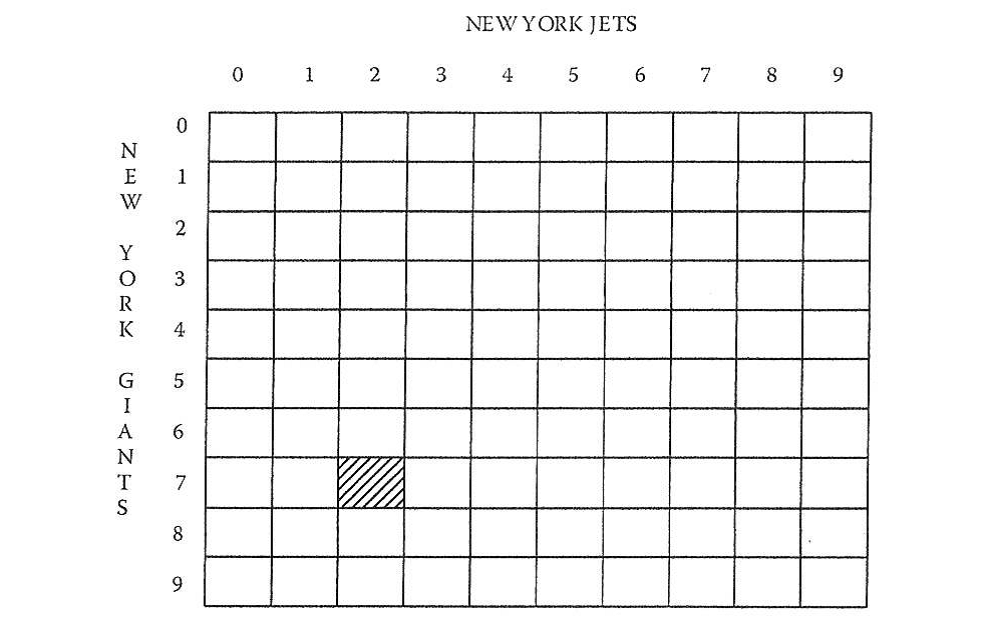
One of the major gambling options during this period is to “buy a box” in a uniquely arranged square, usually referred to as the pool. An example of a pool is shown in Figure 1 for a Giant-Jet game. As can be seen, there are 100 boxes. If each box costs $1,000, the total cash pool is $100,000. The individual, who correctly selects the box with the last digit of the final score for each team takes home the bacon, i.e., wins the $100,000. If the final score is Jets 22/Giants 7, the owner of the shaded box is the winner. Scores such as Jets 12/Giants 27 or Jets 22/Giants 37 would also serve as winners for that box.

nonrandom pool
FIGURE 1 Nonrandom pool.
However, employing the format in Figure l does not provide each person buying a box an equal chance of winning. Knowledgeable football fans would immediately realize that the best numbers to select are 0 and 7, whereas the worst are 2, 5, and 6; therefore, the arrangement of the box as in Figure 1 does not provide each bettor with an equal chance to win. This bias can be removed, and the bet reduced to one solely of chance by assigning the numbers to each team in a random manner after individuals have paid and selected a box. The procedure most often used is to write numbers from 0 to 9 (each) on a piece of paper. The 10 pieces of paper are then randomly drawn from a container and sequentially placed along the side of the square – first horizontally and then vertically. The result might look like Figure 2. Had the same box been selected (see Figure 2), the bettor’s last team digits would be Giants 2/Jets 0. A final score of Giants 42/Jets 30 would be a winner as would Giants 12/Jets 20.
random pool
FIGURE 2 Random pool.

Many gambling activities are available and legal in the U.S. However, the above form of gambling is not legal although it is practiced in private clubs, bars, parties and homes. For example, the football boxes have become an integral part of an annual party that I host at our home for the Killeen’s Tavern basketball team of yesteryear. One of the keys in this betting venture is to ensure that the individual running the box activity does it in a manner that is fair and that the odds are not heavily weighted in favor of the “concessionaire.” Generally, 5 to 10% of the total pool is considered reasonable compensation or takeout for running this illegal business/gambling activity. For whatever it’s worth, there is no takeout at our party, i.e., all of the money is returned to the winners.

The topic of March Madness invariably arises in any discussion of this form of gambling. The NCAA Men’s Division 1 Basketball Championship, or March Madness, is a single-elimination tournament – known as the Big Dance – held each spring and features 68 college basketball teams battling to determine the national championship. The box activity has recently worked its way into this sports venue. And, believe this or not, but the box activity is also part of the gambling that takes place with the World Series. Once again, it is the last digit of the final score of the game. Thus, the key box numbers for a winning final score of 11-3 are 1, 3.

Good luck to those of you who participate in the football box pool this month and beyond.

It’s also that time of the year. Merry Christmas, Happy Holidays, and Happy New Year to the newsletter readers.

Lou Theodore

NEXT POSTINGS: (tentative)

FEBRUARY 1: On Great Eats
MARCH 1: On the SATS
APRIL 1: On Paying Student – Athletes III
MAY 1: On School Taxes


Hofstra Men’s Basketball: There is Hope on the Horizon

November 30, 2014

December 1, 2014
One of my articles last December was entitled: “Hofstra Men’s Basketball: Is There Hope on the Horizon?” Well, December has arrived and that can only mean one thing: it’s time for Hofstra Men’s Basketball. And this year, the title is “There is Hope on the Horizon.”

Gone is Hofstra’s lifetime superstar Charles Jenkins. Gone are Mike Moore and shot blocker Greg Washington. What’s left? Let’s find out about the present squad.

First, and perhaps foremost, is the 2nd year coach, Joe Mihalich who I ranked in my upcoming book, “Basketball Coaching 101” as the 2nd best coach in the county. (However, my colleagues claim that the statement is based on the fact that Mihalich is the only coach who talks to me.) And who is Joe Mihalich? Credit is due to Hofstra’s outstanding Athletic Director Jeff Hathaway who somehow managed to convince Mihalich to leave Niagara University and resettle at Hofstra. Hofstra now has a Men’s Basketball roster comprised of student-athletes who under Mihalich’s direction, have been as equally focused on their schoolwork as on Mihalich’s playbook, and managing to stay out of trouble. So in a very real sense, Hathaway will deserve credit if and when there is a turnaround in the basketball program.

Second, are the players. There are, relatively speaking, massive changes here. The returnees include Dion Nesmith (who was shockingly granted an additional year of eligibility), Jamail Robinson – who I predict will be a big surprise this year, and Moussa Kone – who may have difficulty getting playing time at center. The new additions are the wild card. Included here are transfers Juan’ya Green and Ameen Tanksley–transfers from Niagara, SMU transfer Brian Bernardi, redshirt freshman guard Eliel Gonzalez, Rokas Gustys from Oak Hill Academy, transfer Malik Nichols, and freshman center Andre Walker. This is truly a quality group.

The third factor is the Conference itself, the CAA (Colonial Athletic Association). The quality of both the conference and players have been decreased with power teams transferring out of the Conference and player graduation. It boils down to this: Hofstra is loaded and has a reasonable chance to win the tournament championship and (yes!) move on to the NCAA Tournament.

There is a fourth factor. I believe that the route to basketball championships is through the backcourt. Hofstra definitely will have the best backcourt in the CAA with Jaran’ya Green and Dion Nesmith. These two could probably start for many teams in the country. If the “bigs” can hold their own, my NCAA prediction will very likely become a reality. And don’t forget my sleeper Jamail Robinson.

But there’s more on the fourth factor. As noted, it is the backcourt that usually determines the level of success of a team. But most importantly is the defensive capability of the backcourt. How important is defense? Here is a case and point. Stevie Mejia served as the point (or I) guard for the 2012-13 Hofstra team. Colleagues in press row commented on several occasions that Stevie wasn’t playing at his full potential. What they were referring to was his scoring. Yet, during the season, Stevie stopped the star guards Scott Machado and Michael Alvarado of Iona and Manhattan College, respectively, Cold!, and each were projected first round and second round picks, respectively. I am sure there have been better defensive guards, but he is the best little guard I have ever seen. Furthermore, Hofstra lost three games during the 2013-14 season because of an inability to stop the star guard of the opposing team.

The reality is that defense doesn’t get the credit it deserves in the roll it can play in determining the outcome of a game. The reader should never forget that defense is 50% of the game. DEFENSE IS AS IMPORTANT AS OFFENSE. You can never lose a game if your five starters have the capabilities of shutting down their opponents. However, you can lose a game even if your five starters have the capability of scoring at will.

So, what’s the bottom line? There is indeed hope on the horizon this season despite the 10 wins record last year. The sun will not be setting on the horizon…it will be rising as the strangers on the squad get better acquainted and the freshmen centers mature. I believe that this is going to be an exciting year that may (and hopefully) extend deep into March. Only time will tell whether the hope is real or whether it is just another adjustment year.

Finally, folks do yourselves a favor and consider attending one of the games. Attending Hofstra games still remains the best sports buy in the New York Metropolitan area; it’s even cheaper than going to the movies. There is ample free parking, easy access in and out of the Sports Complex, the concession stands are not a rip-off ($3.25 for a dog, $1.50 for a soda, etc.), and there isn’t a bad seat in the house. Did I mention that its $5 for seniors and children, and the whole exciting atmosphere is conducive to family attendance? I suggest sharing it with someone you care about. I guarantee you won’t regret it.

Note: The above article was written in early November. The team’s record at the time of posting this article (November 28) was 3-2.

Lou Theodore

NEXT POSTINGS: (tentative)

JANUARY 1: On Football Boxes
FEBRUARY 1: On Great Eats
MARCH 1: On the Sats
APRIL 1: On Paying Student Athletes III
MAY 1: On School Taxes


On Paying Student-Athletes II

November 3, 2014

November 1, 2014
The author penned an “As I See It” article titled “On Student-Athletes” near the turn of the century. This was followed by the author’s “As I See It” article nearly 10 years ago titled “On Paying Student-Athletes”. This article is a follow-up to these two papers.

As noted earlier, it is important for the reader to understand that college sports is no longer a sport in the traditional Hellenic sense. It is, pure and simple, a big business that is in the business of providing entertainment in order to make money. Sports is no longer a term that applies at the professional level and most major collegiate programs. Sports has become big business and capitulated to excesses with the corruption that often accompanies uncontrolled capitalism. Bottom line: it has been converted to entertainment. A small group of individuals provide the entertainment and, contrary to American democratic principles and capitalism, are essentially deprived of fair compensation. Most of these entertainers get little to nothing in terms of monetary salaries. A handful are later provided significant financial rewards; it is almost strictly a matter if the entertainers make the pros. In basketball, first round draft choices are guaranteed a millions dollars a year for three years. Second round draft choices get nothing unless they make the team.

Some simplistic individuals continue to view sports and/or athletic events in the classic tradition of the Olympics. It was 500 BC when a handful of Spartan warriors routed the invading Persians at the Plains of Marathon, located approximately 25 miles from Athens. Immediately following the victory, the Olympics were born. The Olympics continued to flourish as a “pure” sport until politics, and more recently, money was introduced into the mix.

Make no mistake about it, the sole purpose of colleges and universities in the old days was to provide quality education. In recent years, these institutions of higher learning have moved into the business of making money. I speak from firsthand personal experience.

And what do we have today? Professional sports are run by the owners, commissioners, and networks in a manner that provides the best in entertainment in order to maximize its profits. Even the officiating is geared toward this end. (Fortunately, the athletes at the professional level have become rich, being appropriately compensated).

Here is what James Michener (my favorite author) had to say in 1990:

“It is still reprehensible for colleges to glean huge profits from their football and basketball teams, while giving their student players no share. I believe that, before the next century, colleges will pay their athletes, and I recommend a system in which a high school graduate who is awarded a scholarship will be allowed 10 years in which to use it. This will enable him to move into the pros while still young and useful, yet obtain his college degree when he is waived out of the league.”

I would go significantly beyond Michener’s position. These athletes, most of whom are anything but students, should be paid. They need representation, just like professional athletes, if they are to receive their fair share. Otherwise, their coaches and individuals like Myles Brand of the National Collegiate Athletic Association (NCAA) will continue to deny them endorsements, gate receipts, TV contracts, etc., on the grounds that such “remuneration will corrupt sports and the amateur ideal.”

One can only wonder if student-athletes (SAs) give thought to what they have given to society. One can only wonder if the NCAA has ever given thought to the SAs role in society. The author believes the suits at the NCAA rarely give thought to the aspirations and the future of the Unsuccessful SAs who would more appropriately be referred to as USAs.

Even after high school, the main problem with many of the SAs is that no one has taught them how to be a star in college. There is television, radio, crowds, press conferences, interviews, etc. Some of these activities are often embarrassing. The main problem with the successful SAs (in this case that means reaching the pros) is that no one, once again, has taught them how to be a star. But what about those SAs who are unsuccessful, i.e., USAs. Once the (senior) season is over, the artificial stage of their college life has ended, and the USAs glamorous world is gone. Kaput! An irreversible happening that will never return.

What happens then? The USA returns to the real world…his home, his city, and in some cases, his country. He is effectively alone within a day. Some do return to their institution and keep in touch with their teammates, and occasionally their coaches, but the contact is inevitably limited. The ending comes quickly as earlier social and professional contacts decrease at an exponential rate.

The former intimacy with both players and coaches dissolves as the USA retreats into another world and is once again simply part of the masses. No longer is everything taken care of by other people; the servants who prepare his meals, outfit him, and provide travel arrangements are now history. And even worse, no one has forewarned him, and no one has taught him to adjust to a new lifestyle.

On March 25th (Greek Independence Day) 2014, a regional National Labor Relations Board (NLRB) ruled that Northwestern University football players are entitled to unionize. Even though authorities appear to be in agreement that this decision will almost certainly be upheld by the national (full) NLRB, lines have been drawn and the NCAA is certain to litigate the decision. This decision could significantly impact the whole spectrum of labor law – including minimum wage, health benefits, social security provisions, unemployment insurance, etc. If upheld, as expected, this decision will (not could) bring the long awaited and justified demise of part – if not all – of the NCAA. I believe that the NCAA will be so crippled by changes that the NCAA, as it is known today, will either disappear or take on a completely different role in college athletics in the future.

There is so much money involved that the sport of college basketball and football will survive. The above court decision will no doubt lead to salaries plus benefits for the athletes, many of whom will no longer be viewed as students. In effect, the term student-athlete will disappear from the dictionary. How, where, and why revenues will be distributed to college athletes – many of whom will be categorized as employees – will be determined by business decisions in the relatively near future.

A colleague and former adversary (on the basketball court) Neal Gillen, a Washington, D.C. based attorney, offered the following “solution” to the SA problem for my soon-to-be-published book titled “Basketball Coaching 101”:

“The issue must be addressed on three separate fronts:
A. An enforceable contract between the school and the student-athlete
B. Changing NCAA eligibility rules
C. Professional leagues agreeing not to sign collegiate players until they or their class have graduated
I have also included provisions for player travel expenses and a monthly stipend to be determined. I did not include a provision for a student athlete to participate in the proceeds of the sale of jerseys, T-shirts, or other memorabilia, but were I to do so, any such payment would not be forthcoming until the athlete or his or her class has graduated. There could be antitrust issues, but should the changes I propose be made and upheld, the game would change once more for the better.

A. Contract between Student Athlete and Educational Institution
The student athlete agrees that in consideration for he or she receiving from the academic institution a four year scholarship that includes tuition, books, tutoring, room, meal, laundry, cleaning, and reasonable travel expenses to and from home at the beginning and ending of each semester, in addition to a monthly stipend during his or her athletic and academic eligibility, said stipend to be determined pursuant to a national agreement between this and other academic institutions and the NCAA, that said student will strictly adhere to the rules and regulations of this academic institution and its athletic department, endeavor to maintain good study habits, participate in all scheduled classes unless otherwise excused because of ill health or playing commitment, will make up any such classes missed, complete all research papers assigned submitting only original research conducted by him or herself, will comport him or herself in a proper moral manner at all times and will refrain from drinking alcoholic beverages, smoking, using narcotics, gambling or providing information about the team’s or a player’s status to known gamblers. Said athlete also agrees that he or she is contractually bound to this agreement, and a breach thereof will require that liquidated damages be paid to the education institution should the player fail to complete the 4-year commitment. Said damages to be determined by arbitration conducted pursuant to the rules of the American Arbitration Association.

B. NCAA Athlete Participation Standards
Effective on a certain date, student athletes in all NCAA Divisions shall be ineligible to participate in varsity sports until their sophomore year, provided they have achieved a minimum 2.5 cumulative average and have successfully completed course work in 32 credit hours. (Author’s comment: This Provision could go a long way toward reducing or eliminating the NCAA academic abuses)

C. United States Professional Athletic Leagues and/or Associations
Players shall not be eligible to contract signatories obligating them to play the professional sport overseen by the governing league and/or association to which a team is a member of and is governed by until his or her college class has graduated unless prior to that date the player in question has earned the necessary credit hours to graduate.”

It all boils down to this: As a former professor, I was paid for chemical engineering education services that were provided to an institution that made money because of the services provided. A SA is not paid for services that are provided to an institution that makes money because of the services the SA provides. Why was I paid and the SA not paid? Isn’t this country a democracy that operates with an economic system based on capitalism? The NCAA apparently does not believe that James Madison’s Constitution applies equally to all – only to some of us.

Folks, Hamlet was right. Something is rotten, terribly rotten.

Perhaps Alex Karras, Detroit Lions defensive end said it best about his scholastic days: “I never graduated from Iowa. I was there for only two terms – Truman’s and Eisenhower’s.”

Lou Theodore

NEXT POSTINGS: (tentative)

DECEMBER 1: On Hofstra Men’s Basketball: 2014-15 Season
JANUARY 1: On Football Boxes
FEBRUARY 1: On Great Eats


HOFSTRA MEN’S BASKETBALL 2013 – 14: THERE IS HOPE, I THINK

February 16, 2014

February 15, 2014

The Hofstra men’s basketball season is better than 2/3 over, so it’s time to revisit an earlier article entitled, “….Is There Hope on the Horizon?” Their current record is 8-17 overall, and 4-6 in the Colonial Athletic Association (CCAA), including a thrilling come-from-behind (15 point) victory this past Saturday over UNCW. So, is there hope? The answer is a qualified “yes.” Here is the basis for this assessment.

The team’s record is not a true measure of the capability of the team. Remember, this is/was supposed to be a “recovery” and/or “rebuilding” year under new coach Joe Mihalich. It also turns out that several of the losses could have gone the other way; here’s my call on why they didn’t.

1. There has been a commitment to an 8-man rotation that primarily involves 6 players. Injuries to two starters – Nesmeth and Allen (still out) – has exasperated the rotation scheme.
2. There was an inability to effectively stop the inside offensive game of several of their opponents. Hofstra’s three big men have done an adequate job but have been outmanned during a few of the games.
3. An inability to stop the premier point guard of some of their opponents added to the team’s woes. Last year, Stevie Mejia (the best defensive point guard I’ve ever seen) put Machado of Iona College and Massenat of Drexel in his hip pocket. Machado had a field day this year that resulted in a loss. Perhaps a box-and-one or a triangle-and-two would help at crunch time.
4. There was a failure to get back on defense to prevent (easy) fast-break points during several games. This effectively provides the opponents with layup practice. As I’ve always said: you can’t beat taking layups. Players need to understand the need to run back – not walk or jog – when there is a change of possession.
5. An occasional porous defense existed when playing zone. Although there are times when a zone is the defense of choice, I’ve always maintained that your grandmother can guard you in a zone. Since one can relax defensively in a zone, coach Mihalich may have opted for some zone because of his short bench.

Overall, coach Mihalich has done an excellent job with the hand he has been dealt. In addition, the team has played with intensity on both offense and defense. Seniors Upshaw (perhaps the most outstanding player in the CAA) and Nesmith are the team’s two best players. Freshman Jamall Robinson has been Rookie of the Week on several occasions and will no doubt emerge as the team’s star the next three years.

Finally, I need to pass judgment on the upcoming CAA Tournament Championship during March 7-10. It is a 4-game playoff over 4 days where anything can happen. And, the winner of the CAA Tournament gets an automatic invitation to the NCAA Tournament starting in mid-March. Hofstra’s only hope to land in the NCAA field is to win the tournament outright. But, winning the tournament – which is not totally out of reach because of the present parity in the CAA – will require playing and winning games on four consecutive days. That probability will be reduced because of a strained manpower that will arise playing with a 7-man rotation. Nevertheless…..anything can happen.

As noted on numerous times in the past, attending Hofstra games still remains the best sports buy in the New York Metropolitan area. There is ample free parking, the concession stands are not a rip-off, there isn’t a bad seat in the house and its $5 for seniors and children. Three home games remain: Delaware, 2/19, 7:00PM, Drexel 2/22, 7:00PM, and James Madison (homecoming), 3/1, 7:00PM.


2013-14 HOFSTRA MEN’S BASKETBALL: IS THERE HOPE ON THE HORIZON?

December 1, 2013

December 1, 2013

December has essentially arrived. That can only mean one thing: it’s time for Hofstra men’s basketball. Gone is their once-in-a-lifetime superstar Charles Jenkins. Gone are Mike Moore and shot blocker Greg Washington. Gone are Mo Cassera and several of his recruits. What’s left? Athletic Director Jeff Hathaway told me that this is supposed to be a rebuilding year for Hofstra. Let’s find out about the present squad.

First, and perhaps foremost, is the new coach, Joe Mihalich (former Hofstra great Speedy Claxton will serve as one of Joe’s assistant coaches). I have always and consistently ranked Davidson’s Bob McKillop (of Lutheran High fame) as the top coach in the country. But, given Joe’s credentials and past performance at Niagara, he may be the second best. I need to note that several of my colleagues claim that these comments are based on the fact that these are the only two coaches who talk to me.

Landing Joe has to be Athletic Director’s Jeff Hathaway’s major coup. Joe brings an awful lot to the table, including a great sense of humor. At one of the press conferences, Joe indicated that Louisville might be favored in their upcoming game, and then reminisced how his Niagara team had lost to Kansas in the NCAA Tournament at the buzzer by 40 points.

Regarding the team, the key returnees are forward Jordan Allen, and forward/centers Moussa Kone and Steve Nwankoni. I expect a big year from Allen, a multifaceted underrated soph, to play an important role. The new additions include Chris Jenkins (no relation to Charles), and transfers Dion Nesmith and Zeke Upshaw (both terrific finds). Freshman Jamell Robinson and walk-on Adam Savion appear to be pleasant additions. Allen, Kone, and Nesmith are presently starters.

The team is off to a 2-4 start, with losses to Monmouth, Louisville, Richmond and Belmont. However, the team’s record is certain to improve as they go deeper into the season and Colonial Athletic Association (CAA) play begins.

The team may have to reinvent themselves before moving toward the next level, and that will not happen overnight. With some many new faces, team chemistry will take time. The biggest question mark will no doubt center on finding a consistent scoring threat who may turn out to be Upshaw. I think there may also be a lot of building for the future. But, the building blocks are in place, with two outstanding transfers who are ineligible this season.

Entering the 2013-14 season, the team will be looking to turn the page on last season’s disasters. The Pride will welcome back just four players who saw action last season so Joe may rely heavily on the aforementioned newcomers (Upshore’s 37 vs. Louisville and Nesmith’s 27 vs. Hartford), including players that sat out last season.

I believe this year represents an excellent opportunity for the team. It’s a young team with a lot of new players, a new coach, and a group that should get better as the season goes on. Remember, there 9 teams left in their conference – the CAA. If they are playing above-average by the end of the season, things may change – and only for the better. Anything can happen. And, the winner of the CAA Tournament in early March gets an automatic invitation to the Big Dance.

The bottom line: I offer this to the fans in the reading audience relative to the question raised in the title to this piece. There may be hope for this season. Only time will tell whether the hope is real or whether it is indeed just an adjustment year.

Finally, folks do yourselves a favor and attend one of the games. The past enthusiastic support of the Hofstra student body at the games is contagious. For me, attending Hofstra games still remains the best sports buy in the New York Metropolitan area; it’s even cheaper than going to the movies. There is ample free parking, easy access in and out of the Sports Complex, the concession stands are not a rip-off ($3.25 for a dog, $1.50 for a soda, etc.), and there isn’t a bad seat in the house. Did I mention that its $5 for seniors and children, and the whole exciting atmosphere is conducive to family attendance? Share it with someone you care about. I guarantee you won’t regret it.

Lou Theodore

Earlier articles:

June 1: On the School Budget Results
July 1: On the New New York Racing Association
August 1: On the New Cooper Union
September 1: On Chaste, Pristine and Random Thoughts XIX
October 1: On the Barack Hussein Obama Legacy II
November 1: On the OHI Day
December 1: 2013-14 Hofstra Basketball: Is There Hope on the Horizon?

On the Calendar:

January 1: Revisiting the East Williston School District
February 1: On the New York Times
March 1: On Chaste, Pristine, and Random Thoughts XX
April 1: On the Barack Hussein Obama Update III

MAILBOX:
Hi Lou,
I just got a computer and learned how to congratulate you for a splendid OHI reminder to readers of the Garden City News. Good work as always. You are and always will be tops in my memory as will Greece and all Greeks.
Corrinne


Once Again, It’s Hofstra Time . . . Unfortunately

December 6, 2012


December 7, 2012


Each of the last eight years, I have had the pleasure and good fortune to attend and write about the men’s basketball team of Hofstra.  I have also claimed that attending these games at Mack Arena is the best sports buy in the metropolitan area.  But this one’s different, and it wasn’t an easy one to write.


Two weeks ago, the Hofstra community and part of the basketball world were rocked with the revelation that four Hofstra men’s basketball student-athletes (S-A) were involved (allegedly?) with stealing electronic equipment, including laptops, cell phones, iPods, etc.


My take follows.


I’m in the process of writing a book on college basketball.  In the last chapter, which is concerned with the future of the game, I predict another major scandal involving shaving points and fixing the outcome of games.  Why?  Because the National Collegiate Athletic Association (NCAA) has put in place one of the all-time great scams on the public.  The S-As provide the entertainment that generates billions of dollars for the NCAA, and yet, they never see a piece of this monstrous, gigantic financial pie.  T-shirts and sweatshirts are marketed with their names and numbers on them, and yet, the NCAA makes certain they don’t get any royalties.


The NCAA has perpetrated this fantasy myth of a S-A that includes the requirement that the S-A live a life of poverty during their scholarship years.  Many of the S-As playing basketball (as well as football) in the major schools are not only poor but also anything but students.  Hell, some of them can’t even spell “student” after graduation.  For example, some time back, one S-A spelled student “stutan”; another worded the answer “yes’ on his application to the question on “sex.”  All of the above is compounded by the fact that they come from low-income families – in effect, they’re broke; which is why 3 of the 4 were not able to post a measly bail.


So back to the Hofstra players.   We are all a product of our society and environment.   These four certainly didn’t know the difference between right and wrong.  Who’s to blame?  Their parents?  Their church?  Their school?  The NCAA?  No doubt, a combination of all four.  And, no doubt, they will be made an example by District Attorney Rice and some school administrators, with all but the four kids essentially being absolved on any wrongdoings.


I am ashamed to admit that a well-to-do close friend of mine occasionally steals money from someone dear to him who is rich beyond words.  When I prod him on what his God would think and/or how he handles confessions, his response is that the person could definitely afford it and would not miss it.  How’s that for logic from a college-educated adult?  Can one draw an analogy between my friend and these four?  And how about the white-collar crimes committed on a daily basis on Wall Street, business,
and government?  And what about those who cheat on their income taxes? I kept this in mind when thinking of these four, realizing that although their crime was more personal in nature, none of the others described above would be punished, or even reprimanded.


It is also important to note that these kids did not commit a violent crime.  No rape.  No muggings.  No beatings.  No murder.  Should they be penalized?  Of course, but we should keep in mind that there are rapists and murderers walking around scot-free.  I do hope the four are penalized, but I also hope they will be given a second chance.  That is something we all deserve for our indiscretions, particularly those of a first-time nature.


I was asked how do I really feel.  There was essentially no surprise, but there was disappointment and sadness.  Sadness more than disappointment.  Sadness because of the impact the conduct of these four young men will have on not only those who love them, but also their coaches, teammates, friends and classmates, as well as all the legitimate S-As who do the right thing.  I also feel for these four youngsters (three are 18 years old) and hope they realize that their world has not come to an end; they still have a lifetime to live.


Here are comments from two colleagues/friends:

Jack Powers,former Executive Director of the National Invitational Tournament (NIT), picks it up from there.  “You have to feel sorry for everyone involved.  This was different from some of the recent battery and rape cases involving some basketball programs.  What they did was wrong but no one should jump to conclusions regarding punishment.  I would need to know more about each kid.  Perhaps a year’s suspension would be appropriate.  But they shouldn’t totally shut the door on some of these kids.  We all did crazy things when we were young.  I’m reminded of the saying ‘people in glass houses shouldn’t throw stones.’”

Dr. John Wilcox, former Director of the Center for Professional Ethics and my ethics book coauthor, continues the outside narrative.  “It’s important to understand that these four are not hardened criminals.  Putting them in jail really won’t serve any useful purpose.  Some form of rehabilitation is in order and one can only hope that they will become a useful and integral part of society.”


In the final analysis, it’s safe to say that this is a sad commentary for the four boys, their families, and the NCAA.  One can only hope that this will play out in a fair, just and compassionate manner, and others will learn from what occurred at Hofstra.


Visit the author at http://www.theodorenewsletter.com


Once Again, It’s Hofstra Time

December 6, 2012

November 23, 2012

It is mid-November.  That can only mean one thing:  it’s time for Hofstra’s men’s basketball.

Athletic Director Jack Hayes told me that this is supposed to be a rebuilding year for Hofstra.  Gone is their once-in-a-lifetime superstar Charles Jenkins.  I can still hear the student body’s haunting chant of “Char – les Jen – kins.”  The relentless passage of time has unfortunately altered Hofstra’s comfort zone.  Everybody thrilled to Charles’ last-minute heroics as he, time and time again, extricated the team from certain defeat.

But he is now gone.  Well, not really, He was in attendance at the season opener this past Friday.  (The NBA is still in lockout mode at the time of the submission of this article.)  He signed autographs, including one on our grandson’s #22 jersey—the number was retired at the end of last season.  I commented at the press conference that senior guard Michael Moore was the heir apparent.  Me and my big mouth.  I was effectively told:  there is no heir to Charles.

Back to the present team.  It may indeed be a rebuilding year.  But Moore—a terrific player is his own right—and Nathaniel Lester—an excellent underrated small forward—are back.  The big question is whether they can make up for the team’s lack of height.

Prior to last Friday’s home opener, Coach Mo Cassera told me they were undefeated.  Well, Hofstra beat Long IslandUniversity (who made the NCAA playoffs last season) by 20 points after leading by 30 points late in the game.  So Mo, you’re still undefeated.

Mike and Nat?  They scored 23 and 33 points, respectively.  The Team?  They played great, with a level of intensity I haven’t seen in a while.

The team is off to a good start with a 1-0 record at this time.  Their next game is this Saturday afternoon at 4:00 P.M. Folks do yourselves a favor and attend one of their games. The enthusiastic support of the Hofstra student body at the games is contagious. For me, attending Hofstra games still remains the best sports buy in the New York Metropolitan area; it’s even cheaper than going to the movies.  There is ample free parking, easy access in and out of the Sports Complex, the concession stands are not a rip-off ($3.25 for a dog, $1.40 for a soda, etc.), and there isn’t a bad seat in the house.  Did I mention that its $5 for seniors and children, and the whole exciting atmosphere is conducive to family attendance?  I don’t think this is an exaggeration, but every home game last year turned out to be a thriller.  It was raw excitement.  Share it with someone you care about.  I guarantee you won’t regret it.