ON PURELY CHASTE, PRISTINE AND RANDOM THOUGHTS XXII

August 30, 2015

Once again, here is another of the “random thoughts” articles.  These are easier to write and appeared to be enjoyed by the readership.  So, here comes 20 of the random variety.


  • I’m convinced that cooking over burning charcoal can’t be good for your health.  The meat is exposed to emissions that contain unburned hydrocarbons, including small quantities of carcinogens.
  • In football, it seems that every time the quarterback changes the play at the line of scrimmage, it’s a running play.
  • How in the world can 40% of the electorate feel that BHO is doing a good job?
  • I maintain that the best program on TV is “The O’Reilly Factor”.  It’s informative, hard-hitting, interesting, and entertaining.  Nonetheless, I’m still annoyed that O’Reilly failed to acknowledge my dedication to him in one of my recent books.
  • Something has to be done about the lack of productivity of civil servants.
  • Who would you rather have running the country – a liberal or conservative – if you are here illegally?
  • Who would you rather have running the country – a liberal or a conservative – if you are a criminal?
  • Who would you rather have running the country – a liberal or a conservative – if you and/or your family may be harmed by evil individuals?
  • I’m still trying to get an estimate on how many millions of people suffered and died because of the weak-kneed liberal policies of Neville Chamberlain.
  • I’m trying to get a handle on how many people have suffered and died because of the weak-kneed liberal policies of BHO.
  • I’m still trying to figure out who is more corrupt and inept – the NCAA or NYRA.
  • I’ve often commented on how dumb Obama is.  But the two dumbest individuals in government are Nancy Pelosi and (especially) Joe Biden.
  • People are now finally coming to grips with the corruption within the NCAA.  The recent findings of the phantom programs, inflated grades, no-show courses at the University of North Carolina for the past 20 years is just the tip of the iceberg.
  • A side headline in the 10/22/14 New York Times read “A Steady Loss in Confidence”.  How would one know from the headline that the article was essentially based on the confidence issue associated with Obama?
  • Prior to leaving for an engagement of sorts, how many times has your wife commented, “You’re not going out dressed like that, are you?”
  • My vote for Man of the 18th Century is George Washington.
  • My vote for Man of the 19th Century is one the pioneers who settled the West.
  • My vote for Man of the 20th Century is Winston Churchill.
  • My vote for Loser and Enabler of the 21st Century is BHO.
  • Have I gone off the deep end?  Every now and then, I find myself comparing Winnie to BHO.  Ugh!


Enough?  See you again in 6-12 months.


NEXT POSTINGS:  (tentative)

OCTOBER 1:             On Barack Hussein Obama Update V

NOVEMBER 1:         On Paying Student-Athletes III

DECEMBER 1:          On Hofstra Men’s Basketball: 2015-16 Season


ON ENVIRONMENTAL MATTERS

August 2, 2015

Well, what about environmental matters? I, for one, am anti-environmental…well, sort of. I’m actually anti-environmentalists. These misguided fanatics have gone nuts. It’s so bad that part of our state is considering seceding from New York due to Cuomo’s idiotic fracking policy. But then again, am I qualified to pass judgement on environmental matters and the USEPA? You be the judge, but I was employed (one year) and served as a consultant to the USEPA (for thirty-eight years).

Here is where we are today. The air has never been cleaner. The water has never been cleaner. The land has never been cleaner. Period. End of report. Conclusion: environmentalists no longer have anything to hang their hats on. But, wait! They have today set out to cripple capitalism, American businesses, and the American Dream. Bad enough? Here’s more. Thirty-five years ago, our environmentalist friends (they are actually our enemies) construed that the Earth was cooling and there was a need to, once again, rally the troops against the new enemy on the block – global cooling. But, wait! The Earth is not cooling. The Earth is actually warming. Finally, they have a cause to create havoc. But, wait! The Earth is not actually warming. But, wait! The Earth is undergoing climate change. Another opportunity to rally the gang for yet another environmental disaster facing mankind. But, wait! Many of the climate changes occurring today also occurred in past. What to do? What the hell. We can still lie, manipulate, deceive, fabricate, etc., since most of the electorate aren’t that bright. In fact, they’re dumb. No problem. Full speed ahead. Keep the donations and support coming in. I seem to remember that someone once said something to the effect that, “you can always convince a sucker of anything.”

So there are two environmental problems (there are, of course, more) vexing your author: global warming/climate change and the USEPA. Each is addressed separately below.

The “greenhouse effect” is a phrase properly used to describe the increased warming of the Earth due to increased levels of carbon dioxide and other atmospheric gases, called greenhouse gases (GHGs). Just as the glass in a botanical greenhouse traps heat for growing plants, GHGs trap heat and warm the planet. The greenhouse effect, a natural phenomenon, has been an essential part of Earth’s history for billions of years. The greenhouse effect is the result of a delicate and non-fixed balance between life and the environment. Yet, the greenhouse effect may be leading the planet to the brink of disaster. Since the Industrial Revolution, the presence of additional quantities of GHGs may be threating to affect global climate and the predicted effects of this increase are still debated among scientists and engineers.

The greenhouse effect works as follows. The energy radiated from the sun to the Earth is absorbed by the Earth’s surface and atmosphere, and is balanced by a comparable amount of long-wave energy emitted back to space from the Earth’s surface. Carbon dioxide molecules (and GHGs) absorb some of the long-wave energy radiating from the planet. Because of the greenhouse heat trapping effect, the atmosphere itself radiates a large amount of long-wave energy downward to the surface of the Earth and makes the Earth warmer than if warmed by solar radiation alone. The GHGs trap heat because of their chemical makeup and, in particular, their triatomic nature. They are relatively transparent to visible sunlight, but they absorb the aforementioned long wavelength, infrared radiation emitted by the Earth.

Some believe that the warming of the Earth over the last 100-150 years is part of a long-term, natural cycle that has little to do with the production of GHGs. Many remain unconvinced that the accumulation in the atmosphere of GHGs is concrete evidence of any rise in the average temperature, explaining that any warming of the Earth in the last one hundred years is better explained by the variation in natural climate and solar activity. According to this theory, the most probable source of global warming appears to be variations in solar activity.

The amount of solar rays reaching the Earth is controlled by three elements that vary cyclically over time. The first element is the tilt of the Earth’s axis, which varies 22° to 24.5° and back again every 41,000 years. The second element is the month of the year in which the Earth is closest to the sun, which varies over cycles of 19,000 and 24,000 years. The third element is the shape of the Earth’s orbit, which, over a period of 100,000 years, changes from being more elliptical to being almost fully circular. Finally, the amount of solar energy released by the variation in sun solar flares has a significant effect.

Scientists and engineers have also stated that changes in the Earth’s temperature have followed changes in solar activity over the last 100 years. When solar activity increased from 1880s to 1940s, global temperatures increased. The observed global temperature rise of 1°F was during this period, before 67% increase of global GHG emissions had even occurred. When it declined from the 1940s to the 1960s, temperatures also declined. During this time period, some environmentalists spoke of doomsday tales as a result of “global cooling,” blaming this event on the use of hydrocarbon fuels. When temperatures began to climb again with an increase of solar activity and sunspot numbers in the 1970s and 1980s, environmentalists began singing a different tune. Instead of the devastating effects of worldwide temperature drops, media campaigns began stressing the importance of regulating GHG emissions.

Obviously, the debate among these so-called experts continues to rage. What may be needed is to bring together a group of qualified experts–with no vested interests in the results — to impartially examine this problem analytically via a Delphi Panel Approach.

Here is my take on the global warming/climate change/greenhouse effect/CO2 emissions issue. The entire issue is bogus at this time. The policies of the EPA are bogus. The changes recommended and advocated by environmentalists are bogus. The present ideologies of environmentalists are bogus. Why bogus? There are no hard facts to back up doomsday predictions.

Is carbon dioxide (CO2) a problem? The scientific answer is one cannot say for certain. The engineer’s answer is that it probably is not due, primarily to the complexity of the overall issue. It would therefore not be unreasonable for one to conclude that any effort to curb CO2 emissions into the atmosphere that involve significant economic changes that can impact man’s social behavior cannot be justified. Any effort to reduce and/or eliminate CO2 emissions is thus virtually certain to downgrade the quality of life and lead to an increased state of poverty and instability.

Let’s face it. Any mandated imposition of CO2 emission reductions will dramatically impact our economy. It will result in the loss of at least (depending on the severity of the cuts) 100,000 jobs with little to no opportunities for these jobless to secure satisfactory replacement employment opportunities. All of this will compromise the ability to defend ourselves from the enemy, particularly the Jihadists. This is an example, pure and simple, of EPA know-it-alls (KIAs) involved with energy decision policies, who haven’t thought through the problem and included all the ramifications associated with their policies. Touting solar and wind technologies as the answer is ridiculous since these industries almost certainly will not be cost-effective–a term not in any environmentalist’s dictionary¬¬until mid-century (at the earliest). The KIAs have just chosen not to consider costs and dangers in their analysis.

Environmentalists justify their assessment by arguing that over ninety percent of the technical community support their position. This is misleading since nearly all of the 90% they refer to have vested interests in there being this catastrophic problem facing society. If there is no problem of this nature, most will be out of a job. At a minimum, there will be no tenure, no promotions, no articles, no books, no contracts, etc. And, the environmental organizations who also support this scam will have greater difficulty in generating funding donations and government support. (My experience with government grants is that the likelihood of receiving support is enhanced if the project can in no way serve mankind.) Gone are the days when scientists and engineers were beyond reproach. The reality is that today’s scientist/engineer is as corrupt as the lawyers society has come to detest. In any event, whichever theory one chooses to accept, it is clear that the issue is far from being resolved. Hopefully, unbiased, unadulterated science and not politics or fanatics will call the shots in the future.

On to the USEPA. The present problem that exists with the EPA is an intricate one, consisting of primarily five (5) main concerns:

1. Economically efficient measures are seldom, if ever, adopted, causing little progress in achieving environmental goals.
2. Data collection often has limitations, and when insufficient data is used for legislation, an ongoing string of amendments is attached.
3. The legal issues involving environmental problems have rocketed, brought on mainly by the complex legislation.
4. The EPA is presently primarily a legal organization that is serving the best interests of the law profession rather than the environment.
5. The EPA is presently a politically motivated organization.

Complicated legislation passed based on insufficient data is by no means a solution to the environmental problem. Costly control measures are taken, and in some cases, the public’s risk is increased. As noted, constant amendments are needed, often doing little to alleviate pollution. Regulations can only help if they are based on sound scientific data. When the legislation is unclear, lawyers are often brought in to “clarify” it. Instead, they usually complicate the problems further since lawyers are not trained in engineering and scientific methods.

When the EPA was formed in 1970, it was – in a very real sense – a technical organization. The Agency was manned primarily with engineers and scientists. Most of these individuals were dedicated to a common cause: correcting the environmental problems facing the nation and improving the environment. The problems these individuals tackled were technical, and there were little or no legal complications or constraints. The EPA was indeed a technical organization, run and operated by technical people, attempting to solve technical problems. Much was accomplished during these early years but something happened on the way to the Forum.

The present state of the EPA? Forty-five years later, the EPA is no longer a technical organization – it is now a legal organization. The EPA is no longer run by engineers and scientists. It is run and operated by lawyers. And, the EPA is no longer attempting to solve technical problems; it is now stalled in a legal malaise.

How in the world did this occur? It happened because EPA evolved into serving the best interest of the career bureaucrats in and out of Congress, most of whom are lawyers, and it happened because the technical and business community did nothing to stop it. The result is that this nation is now paying the price for an environmental organization with nearly 20,000 employees and an annual budget approaching ten billion dollars that is not serving the best interests of either the nation or the environment.

Interestingly, all of the administrators to the EPA have been lawyers. Though lawyers are required in every industry to help settle disputes over legalities, protecting the environment was previously beyond their scope. In the EPA today, for every three engineers, there is one lawyer; it is indeed (as described above) a legal organization, serving the legal profession and not the environment. Actual proposals for regulations and control, based on good scientific data, should be designed by scientists and engineers, or those who have come to be defined as problem solvers. They can analytically break down a problem, initially assess the damages, and then fix them.

Something has gone afoul. In our society, engineers are the problem solvers, but rarely the decision makers. Although the world known today has been called a product of engineering, engineers play a minor role in important decision making.

In 1995, the silver anniversary of the EPA, I was requested to submit an article outlining my thoughts on this twenty-five year old (at that time) organization. Five other articles were ultimately accepted for publication (Environmental Manager, 1, Nov. 1995). My article entitled, “Dissolve the USEPA … NOW!!!” preceded that by Bill Ruckelshaus, the first EPA Administrator, who also provided somewhat less than positive comments on the EPA. My thoughts today? It is a useless organization, run by career lawyer bureaucrats, that is not serving the best interests of not only our nation but also society in general. It should be dissolved.

NEXT POSTINGS: (tentative)
SEPTEMBER 1: On Purely Chaste, Pristine and Random Thoughts XXII
OCTOBER 1: On Barack Hussein Obama Update V
NOVEMBER 1: On Paying Student-Athletes III
DECEMBER 1: On Hofstra’s Men’s Basketball: 2015-16 Season


Basketball Coaching 101

June 30, 2015

Since my eight-first birthday is a fleeting memory, what has become apparent is that a good part of my life is now limited to writing and basketball. That being the case, what would be more natural than for me to write a book on basketball, something I’ve dreamed about doing for years. After all, I’ve written over one hundred technical books (all of which have one thing in common–they don’t sell) and also recently launched my monthly newsletter (www.theodorenewsletter.com) that probably has an audience that, at last count, is approaching a dozen readers. In addition, I have been involved with basketball for over seventy years, part of which time involved playing, coaching, officiating, recruiting, and announcing as well as covering Hofstra men’s basketball the last nine years. In effect, all the ingredients were in place for the writing of a book on basketball coaching.

Since I have never played, coached or officiated basketball at the college or pro level, critics may claim that I am not qualified to write a book on coaching. They may be right. But I did serve as the coach of a local bar team–Killeen’s Tavern (I was part owner)–during the mid-1950’s to the mid 1960’s. Several of my players later played in the NBA, and some of them went on to successful coaching careers at the collegiate and pro levels.

Regarding the book, I was able to contact university presidents, athletic directors, coaches, officials (referees), announcers, journalists, recruiters, players, and yes, even fans, in my quest to write an authoritative book on basketball. Each was asked to detail their thoughts on the qualities a coach should possess to develop a winning and successful program. Hopefully, this approach either reduced or eliminated, or both, some of the trepidations of others regarding the quality of the book.

This is clearly not a book of fiction prepared by an author with an agenda; it is primarily a product of the aforementioned experts, written by these insiders with something more than firsthand experience. Their contributions helped make my dream of writing an informative book on coaching basketball a reality. And the title? You got it – BASKETBALL COACHING 101.

And who were these experts referred to above? The reader is introduced to each of the experts in the book. I categorized the experts into ten sets – starting with presidents and ending with fans. A separate chapter in the book is devoted to each of the above categories. Contacts with these so-called experts, e.g., Louie Carnesecca, Rollie Massemino, Bob Hurley, Sr., Mickey Crowley, Wally Rooney, Ray Lumpp, Vince Boryla, Danny Doyle, Jack Powers, Jay Bilas, Bill Raferty, Howie Garfinkel, Bob McKillop, etc., to name a few, were conducted via e-mail or phone or a face-to-face meeting, or some combination of these three information technology communication processes.

This is a very unique book in many respects because I made a decision to include more than just basketball coaching in the book. The book has it all: coaching hints/strategies to employ to achieve a successful and winning program, history of the game, reliving the fabulous 1950’s and 60’s, the aforementioned Killeen’s Tavern’s basketball team, the dark corrupt side of the NCAA, the disgraceful Joe Paterno saga, the future of the game, etc. And, there are also dozens of stories never told before, many of which I believe are hilarious.

Back to basketball coaching. If there were to be a summary analysis of important qualities a coach should possess, it would be–based on the contributions of the aforementioned experts–the following:

1. ability to recruit and retain top players;
2. superior organizational skills;
3. ability to develop team chemistry;
4. hire super assistant coaches;
5. knowledge of game;
6. dedicated work ethic;
7. a great motivator and a great communicator;
8. love of the game;
9. social/people skills;
10. leadership qualities;
11. ability to work with school administrators and the media;
12. concern for the players’ education and future;
13. ability to accept losses;
14. being a role model; and,
15. character builder.

Ranking the above in terms of importance can vary with the coach, the academic integrity of the school, the level of (Division) play, etc. However, I would rank the first ten qualities as the most important, particularly the first four. Details provided by the experts on these qualities and how a coach can help achieve these qualities are discussed in the book.

Below is a sample quote from Chapter 23, Part II, titled “On Paying Student-Athletes:

“In any event, here is the “paying S-A” situation as it exists today. At the college level, the coaches get paid millions and the players get paid nothing. At the next level, the coaches get paid millions but the players get paid many more millions. Intelligent and objective readers/fans should attempt to explain this dichotomy. This author provides the answer with four letters: NCAA.”

Finally, a few of the early reviews are already in.

1. Jack Powers (Former Executive Director, NIT): “The basketball world can now formally welcome to their midst one of the game’s brilliant strategist. His name is Dr. Lou Theodore, and his new book – Basketball Coaching 101 – has established him as one of the premier authorities in the game.”
2. Danny Doyle (Belmont Abbey/Detroit Pistons): “The annoying little creep first asked me to write a Foreword. Now he wants a review. Here’s my review: Don’t buy the book – he’d just lose any royalty money betting on horses. Yet, it is special and unique from my perspective. This basketball book is written by a legitimate authority without pulling any punches. It is a book for the basketball know-it-alls who are interested in coaching and/or coaching strategies. The back end of the book was touching and brought back yesterday’s memories of our guys.”
3. Louie Carnesecca (Retired coach): “This is an excellent and informative book on coaching strategies, written for all basketball coaches and fans.”
4. Bob McKillop (Basketball coach): “The numerous contributions from authorities in the field (including the author) on coaching strategies make this an invaluable resource for coaches.”
5. Marty Bunce (Former Executive Director, Boy’s Club of New York): “It’s a great basketball coaching book. I lived the Killeen’s era. But the key feature of the book is the NCAA material and the future of the sport. Lou is right. The NCAA‘s reign will soon be over. Their only hope of surviving is to accept that their cheating, lying and exploitation will end. I suggest that the NCAA hire Louie, Neal Gillen, Jay Bilas, and Jon Wagner to develop a solution to the SA problem that will make everybody even richer using Louie’s Delphi Panel Approach.”
6. Wally Rooney (Former NBA basketball official): “Basketball has come a long way. But Lou has somehow managed to capture both the history and the present state of the game. Kudos, Lou. This is a gem. An absolute delight. Beautifully written. Easy to read. Full of basketball information. Entertaining. Unique (an inverted triangle and two defense?). Funny. A winner in every respect.”
7. Jackie Ferrara (NYC cab driver, sports buff): “This is the book for the individual who wants to become an intelligent basketball fan and get a glimpse of the dark side of the NCAA. It took guts to provide a no-holds-barred discussion of the shameful marriage of convenience of Dean Smith, Boeheim, Izzo, Donovan, Pitino, Calipari, Valvano, etc., with the corrupt NCAA.”
8. Dr. John J. McKenna: “(Pres., ETS International): “A very funny book. This is definitely the best basketball book I have ever read. There is a decent chance that it is the best basketball book ever written.”
9. Robert Sansavarino (Mathematical Advisor, Checks & Balances, Inc.): “The book is no bargain. The basketball coaching stuff is OK but it needs more on the gambling aspect of the game.”
10. Alex Zouncourides (Former minor league baseball umpire, teamster rep): “The technical stuff wowed me. Every coach should read this book – it is loaded with information. Plus, I couldn’t stop laughing in spots.”
11. Rita D’Aquino (Former CEP senior editor): “An extraordinary work written basketball works will be judged.”

The book recently came off the press and is available for your scrutiny and possible reading pleasure/enjoyment(?). It costs $17.95 and can be purchased online at Amazon.com or Createspace.com.

NEXT POSTINGS: (tentative)
AUGUST 1: On Environmental Matters
SEPTEMBER 1: On Purely Chaste, Pristine and Random Thoughts XXII
OCTOBER 1: On Barack Hussein Obama Update V
NOVEMBER 1: On Paying Student-Athletes III
DECEMBER 1: On Hofstra Men’s Basketball: 2015-16 Season

Note: The East Williston Recreation Committee hosted a book signing for Basketball Coaching 101 in the Village Hall on Wednesday, June 17 from 7:00 to 8:30 PM. The packed house was well attended by family, friends, basketball aficionados, well-wishers, and many of the contributors to the book. Everyone enjoyed the opportunity to talk about basketball and get their books signed. They also had the opportunity to imbibe in the refreshments that were served through the generosity of the E.W. Recreation Committee. Our thanks go to Caroline Debenedittis for all her help.


On East Williston School District Taxes

April 30, 2015

It’s not like me to report material from previous years, but the next several paragraphs appeared in 2014. I suggest the reader carefully note the contents before moving to more recent happenings. Here is what came down last May.

East Williston School District (EWSD) residents are annually requested to vote on a school budget and this year is no exception. Each voting member of the community will have an opportunity to either vote for or against the budget. Every parent, every senior, every taxpayer, and every youngster of voting age should consider what limited facts have been made available to them.

As many of you already know, I will vote NO on the budget. Why? I simply need to, once again, provide the readers with an earlier (2012) note delivered to Superintendent Kanas following a 1-hour meeting that year. Here is that unedited note:

Dear Dr. Kanas,

I believe that the following current problems are adversely affecting the East Williston School District (EWSD).

1. The per capita student cost is $30,000+/yr.
2. The student/teacher ratio is 9.75:1.0
3. The EWSD employs 21 secretaries.
4. There is rampant teacher absenteeism.
5. There is a failure of some students to attend the college/university of their choice.
6. The EWSD national ranking is in free-fall.
7. The school tax burden continues to increase despite reduced enrollment.
8. There is a lack of preparedness of some of the students for their post high school education.
9. There is a failure of the previous administration to, in accordance with the law, act on FOIL requests.

As a taxpayer and member of the EWSD community, I am requesting your assessment of the above nine problems, plus what steps you intend to take to either remove or reduce these problems. If a response is not received by October 1, 2012, I shall assume that you have concluded that there is no reason for concern. If you do respond, I would then appreciate a follow-up notification on the success/failure of your actions on or before December 31, 2012.

I await your response.

Guess what? Three years have passed, and I’m still waiting for a response. One simple question: Do I deserve a response? Both Kanas and the present Board have chosen to ignore my request. Yet, unlike Kanas and the Board members, I’ve dedicated my life to education, serving as not only a professor and administrator at the College level but also as a member of the Admissions Committee. I also continue to provide free advice to those senior students requesting guidance (apparently there is little to no meaningful guidance presently available at Wheatley) on university and career choices.

That was last year. Another year has passed and things really haven’t changed In fact, they’ve gotten worse. You want proof? Here is what the School Board’s appointed Financial Advisory Committee (FAC) reported in late March on the Board’s request that they provide an objective view on issues facing the District. Suprisingly(?), the FAC did an excellent job. Note, however, that the FAC acts only in an advisory capacity to the Board. In effect, the Board has the discretion to either implement or ignore the FAC’s recommendations. Please keep the word ignore in mind as you delve deeper into this article.

To no one’s surprise, the FAC concluded that there were two obstacles obstructing the EWSD’s path to success: wage and benefits growth.

Here are some specific conclusions from the FAC:

1. Funding for student programs and staff development initiatives continue to increase.
2. The budget and cost per student continues to increase.
3. The Board should explore if there is a positive correlation between spending and student achievement (of course, everyone already knows that there is no correlation).
4. Contractual costs continue to exceed the tax cap growth limits.
5. The budget growth exceeds both the Consumer Price Index (CPI) and Gross Domestic Product (GDP) index.
6. The EWSD budget is growing faster than CPI & GDP due to the rate of increase of wage and benefit expenses.
7. EWSD wages and benefit costs are growing faster than the private sector (any reader think otherwise?).
8. Enrollment has declined approximately 7% from its peak and has been relatively flat recently (actually, it has decreased nearly 10% over the past 9 years).
9. Per student annual costs (approximately $33,000) have increased faster than the budget … and they have never decreased. This has to be shocking when compared to the average annual student cost for County public schools of $25,000 and County private schools of $15,000. Do parents and taxpayers truly understand this disparity?
10. Item (9) explains why the average (note the word average) teachers annual compensation is approaching $175,000.
11. Items (9) and (10) have produced a growth in compensation that is at least twice that of the private sector.

The above disturbing statistics are due to healthcare costs and retirement costs. The teachers only pay 20% of healthcare costs. Healthcare has caused a dramatic increase in the Post Employment Obligation Benefit (PEOB); this is an estimate of the cost to provide post-employment healthcare. This explosive growth would likely bankrupt a private company – and it did for General Motors. The only way to control this is to have employees pay a significantly higher portion of the healthcare costs. Retirement costs have risen from 0.0036% of salaries to approximately 13% of salaries. Thus, for an employee making $100K, these annual costs have risen from $360 to over $13,000. This is simply not sustainable. In the private sector where employees work for a living, the likely result would have been a reduction in salaries.

The FAC also provided a host of recommendations. However, here are two that are worthy of mention.

1. Limit wage growth and increase healthcare contributions.
2. Develop a framework to measure student achievement relative to costs.

Any chance the Board will take action on either of these two meaningful and critical recommendations? “Not hardly,” as John Wayne would put it. Let us not forget that the Board and Kanas are there to represent the teachers, not the taxpayers, seniors and children.

And where does the PTO fit into all of this? Forgive me, but it would be more appropriate to refer to them as TO since they do not represent the parents and their children. As I’ve said in the past, this is unfortunately an organization whose members are just uninformed, or lacking intelligence, or educator/teacher ideologs, or some combination of the three. Not a healthy situation

The teachers’ upcoming contract (salaries and benefits) is the next order of business. The mettle of the FAC will be tested at that time. I predict that the Board will, once again, disregard the reasonable recommendations of the FAC and “accommodate” the teachers at the expense of the parents, seniors and children. If they don’t, many of those who refer to themselves as teachers will go on the warpath as they did 25 years ago. They will, once again, be wearing black armbands, intimidating parents and students, claiming poverty, accusing the community of not caring about education, etc. In fact, they might even parade down to the EW train station at 3:00PM to demonstrate to those parents returning home from work. Last time, the teachers (many of whom are not that bright) were not aware that those who actually work for a living (5-days per week, 50 weeks per year) put in a full day (plus travel) – not a half day like teachers. A truly sad commentary on both past and present EWSD teachers considering the important influence they have on kids.

I conclude with three earlier comments, repeated for the reader’s benefit.

1. Dr. Kanas misrepresented herself when she applied for the position of Superintendent of the EWSD. I repeatedly brought this FACT to the attention of both the Board and PTO. And, guess what? Both ignored the comments regarding Kanas. You’d think that if Kanas had my professional pride, she would offer some response. But I know she can’t defend her earlier behavior. Others in sports, education, business, technology, etc., are automatically dismissed for this sort of conduct.
2. CONNED!!! That’s what has happened to the EWSD parents and taxpayers. They have been sold a bridge on the quality of education and the dedication of the teachers. They have simply been duped.
3. The turnaround will come when the community comes to realize that Board members – in almost every instance – are there for self-serving purposes. If they really cared about the kids, they would not move on once they have graduated. Think about past Board members who were so vociferous and outspoken about defending the status quo … a status quo that has resulted in higher taxes and a decrease in the quality of education.

The bottom line: It’s OK to vote NO on the budget. Don’t be a glutton for punishment. Stop being taken for a fool. Stop being an enabler for the EXPLOITERS on the Board and some PTO officers.

Lou Theodore

NEXT POSTINGS: (tentative)
JUNE 1: On Memorial Day VII
JULY 1: On My Book
AUGUST 1: On Environmental Matters
SEPTEMBER 1: On Purely Chaste, Pristine and Random Thoughts XXII
OCTOBER 1: On Barack Hussein Obama Update V
NOVEMBER 1: On Paying Student-Athletes III
DECEMBER 1: On Hofstra Men’s Basketball: 2015-16 Season


On Paying Student-Athletes III

April 2, 2015

It’s the Big Dance. It’s the Final Four. It’s March Madness. It’s . . . could there be a better time to discuss the NCAA and the nagging issue of paying the so-called student-athletes? So, here we go again.

This is the author’s third article in this series following an article on March 1, 1999 titled “On Student-Athletes.” The first article (May 2, 2003) was titled “On Paying Student-Athletes.” The second and most recent article appeared five months ago and was titled “On Paying Student-Athletes II.” It would be reasonable to ask: Why the need for another article? Well, there is a need because of both the interest of the basketball community and the rapidly changing landscape on this subject. Here is a recap and some brief introductory material.

One phrase comes to mind when referring to the NCAA and it involves the present state of the NCAA. One need only refer to the classic statement of Lord Acton (John Emerich Edward Dalbery): “Power tends to corrupt; absolute power corrupts absolutely.” I wonder if the good Lord was thinking of the NCAA when he first uttered these words. There is also a companion statement to the above: “Unlimited power is apt to corrupt the minds of those who possess it.”

The present role of the NCAA? It depends on whom you talk to. The NCAA would have you believe that they are God’s gift to both college sports and their so-called “student-athlete,” (SA). But there are many, including your author, who aren’t buying it. I described the NCAA earlier as “a corrupt organization that has perpetrated one of the biggest scams on an unsuspecting public.” In addition, in his book Unsportsmanlike Conduct: Exploiting College Athletes, former NCAA President Walter Byers describes the NCAA’s operation in the following manner. “Today the NCAA Presidents Commission is preoccupied with tightening a few loose bolts in a worn machine, firmly committed to the neo-plantation belief that the enormous proceeds from college games belong to overseers (administrators) and supervisors (coaches). The plantation workers performing in the arena may only receive those benefits authorized by the overseers.” WOW!!! And this from a former NCAA President who ought to know what’s going on. Today, the NCAA is standing firm: no pay for student-athletes.

It was Bill Bradley who once commented during an interview that “professional basketball is not a sport in the traditional sense – it is entertainment.” And entertainment is directly tied to business. And business is often tied to corruption. The games need to be entertaining and that usually requires competitive games. Blowouts are a no-no for attendance and (more importantly) TV ratings. And unfortunately, all the above has filtered down to the NCAA. Bottom line: The NCAA is in the business of making money – not improving the educational system or paying those individuals who deserve to be paid. Those who believe otherwise . . . well, I have a bridge to sell them.

It is fair to state that the main objectives of athletics is the development of not only the body but also the mind, heart, and soul. Higher institutions of learning may therefore be viewed as a participant in this development business. On the surface, much can be gained from college/university athletics. Unfortunately, the original principle of the Olympians has eroded over time, leaving in its wake a development business that is primarily in the business of making money; in effect, it has destroyed or at least tainted the earlier concept of athletics. Thus, one concludes that college/university athletics have become an integral part of an institution’s inner workings, and in particular, its bottom line. Schools have become hostages to athletics as the NCAA has evolved into a multi-billion dollar business. And, as we all have come to appreciate, with this kind of money comes the aforementioned corruption. Unfortunately, the NCAA has embraced this corruption.

And then there is the recent (2014) findings at the University of North Carolina regarding fake classes for approximately 1500 so-called SAs over a twenty-year period. Terms like “inflated grades,” “bogus classes,” and “shadow curriculum” were tossed around. As columnist Jon Wagner recently put it, “we are somehow outraged, even when we know all too well that winning and money often trump things like learning and the earning of degrees for top college athletics.” But, overall, there was shock to many in the media. Really? This is standard practice at most Division I schools, and when the president, athletic director, coach, assistant coaches, etc., all claim they didn’t know, they are either lying or deserve to be fired for ignorance and stupidity. Face facts: many of these SAs read and write at or below 6th grade level.

Guess what happened after the above UNC allegations surfaced: if you guessed – nothing – you would be right. Where is the university in all of this? Where is Roy Williams in all of this? Where is the Athletic Director in all of this? Where is the President in all of this? Where is the spokesperson for Dean Smith? Where are all the other coaches? And, where is the media in all of this? The key question I would ask: how could something like this not receive more attention in the media? They made a federal case out of a kid accepting a free burger. The answer is that there is simply too much money involved to upset the applecart. At this point in time, nobody knows who the guilty individuals are and exactly what Roy William’s role was.

And if it happened in Chapel Hill, it no doubt also happened in Durham. And in Syracuse. And in Gainesville. And in … after all, who’s kidding who? These coaches and their program/associates/accomplices are almost certainly guilty and complicit. As noted above, I have a bridge to sell those in the reading audience who don’t believe this statement is true.

Here is the latest on this SA academic integrity activity. The head of NCAA enforcement says academic misconduct has been on the rise in college athletics and his department is handling twenty open investigations. The cases involve both prospective and incoming athletes trying to become eligible for college competition, and enrolled athletes receiving impermissible assistance from university and athletic department personnel. Eighteen of the cases involve Division 1 schools. As Claude Rains once put it, “I’m shocked ….” Shocked? Given the NCAA policies, many of my colleagues in the basketball community have argued that institutions that don’t cheat are doing a disservice to their institution.

You want more? Syracuse University and Jim Boeheim had a case pending before NCAA Committee on Infractions regarding academics, drug policy, and improperly allowing certain players to practice. The penalty was severe and included a nine game suspension and the loss of twelve scholarships over four years. Boeheim graciously commented that “the universe is doing the right thing by acknowledging that past mistakes occurred.” The reader can be virtually certain they are still occurring at not only Syracuse but also at most other major programs.

Why is all of this still occurring when everybody knows about it? There is a simple answer to the question: there is so much money involved with so many people making so much money that no one wants to lose their piece of the pie, jeopardize their present position, and reduce/eliminate even future gains. The end result is that many presidents, ADs, coaches, media personnel, etc., sit idly by and allow it to occur. Simply put, for coaches, almost all – if not all – are cheating to some degree.

Who’s to blame now becomes the question. Most of the SAs are in 17-22 age range. Think back to that time in your life. If it happened to the author or the reader, no one would be surprised. After all, these SAs were no doubt told that they were part of a system that one could view this conduct as a “tradition.”

Face it. This sort of conduct has become a way of life in big-time programs. Everybody, and I mean everybody, has bought into this behavior where the SA is not paid his fair share. They are all complicit. Who is the responsible individual? One will have trouble trying to track down who this person is. It is just like what has happened and is happening at the federal level of government with the lies along with manipulative and deceitful behavior.

Can this conduct, particularly that of not paying SAs, be corrected? I believe that everybody should be held accountable. This includes the aforementioned coach, assistant coaches, AD, president, board members, players, secretaries, etc. The rule or policy should be that the complicit individual(s) are fired and/or dismissed.

In the meantime, the dance goes on . . . at least for now. But there will be a changing of partners in the near future. That is a given.

P.S. There was an interesting twist to this year’s NCAA Tournaments. Yale University (you can check their record) was as competitive as some of the teams that received at-large bids for March Madness and as competitive as nearly all of teams that reserved at-large bids for the NIT tournament. Yet, they weren’t selected even though they definitely deserved to be selected. Why? Some will say this is speculation but I firmly believe that it was based on Yale’s team consisting of legitimate student-athletes (SAs) while many of the aforementioned teams were primarily manned by athletes. Remember that Yale only played on weekends so that the games would not interfere with the players’ academic program. I believe the Yale team and its players are unquestionably an embarrassment to the NCAA. I therefore can’t blame the NCAA for not providing an opportunity for Yale student-athletes to complete against the athletes in the other programs; it would serve as another reminder that the NCAA is continuing to perpetrate the scam on the public of its student-athlete fantasy.

NEXT POSTINGS: (tentative)
MAY 1: On School Taxes
JUNE 1: On Barack Hussein Obama IV


On the SATs II

February 28, 2015

March 1, 2015

The past months brought two things to mind for many of our local high school sophomores, juniors and seniors. It is/was a time for those considering college to either take the SATs for the first time or improve earlier SAT scores.

Well, what does the SAT stand for? It is an acronym for Scholastic Aptitude Test. The SAT prior to 2005 was based on a maximum score of 1600. The current SAT scores can range from 600 – 2400; the score is based on three 800 point sections:

1. Mathematics
2. Critical reading
3. Writing

However, the College Board – who owns and operates the SAT – announced last year that it would revert back to the earlier 1600 maximum grade scale. Unfortunately, there is little sample material available for the new SAT that will debut in early 2016.

The previous paragraph provided a short history of the SAT. But the SAT, like environmental regulations and the Professional Engineering (PE) test, is a moving target. Thus, this article is primarily concerned with the new SAT, the SAT that will be employed starting in early 2016. Hopefully, this article should be primarily of interest to high school sophomore students and their parents. It should also be of some value to juniors and seniors.

There are seven key changes to the new SAT. The new test includes the following topics:

1. Relevant words
2. Applying available evidence
3. Analyzing an essay
4. Problem solving and data analysis (math)
5. Real world applications in science
6. History/social studies analysis
7. Formulating documents discussion/analysis

In addition, the wrong answer penalty has been removed.

Although I believe the above are positive changes, there are two topics that should be introduced and expanded upon – communication skills and solving/addressing open-ended problems. Details on both these subject matters follow.

Communication skills need no introduction. More than anything else, both technical and business personnel in the future will have to be able to communicate both orally and in writing. There is an old saying that a graduate from an Ivy League university can’t count and an MIT (Massachusetts Institute of Technology) graduate can’t read or write. But today, successful individuals must be able to express themselves in both oral and written communication. Technical and business ability is of little use if one cannot transmit ideas to others. In addition, the major contact one has with other administrators of an organization who can determine raises and promotions is through written communication. Oral and written communications are therefore important in all fields. Well, what about the word communication? Communication has been defined by some as an act of expressing ideas, especially in speech and writing, by others as an act of transmitting ideas or information, and still others, as an exchange of information or messages by speech, writing, and so on. The word oral implies something uttered by mouth, spoken, or involving the use of speech, while the word written is defined as an expression recorded in a readable format, such as books or other literary material, or an idea that is “put into writing or written form.” What does the above mean? Communication is important, particularly in today’s high-technology and Internet environment.

In terms of introducing open-ended problems, the cliché of the creative individual has unfortunately been aptly described throughout history – the Einsteinian wild hair, being locked in a room for days at a time, mumbling to oneself, eating sporadically, being lost in a fog of conflicting thoughts, not paying attention to one’s hygiene, working diligently until those times when the “light goes on” moment of discovery, etc. It is no secret that technical and business personnel in the future will have to be innovative and creative in order to succeed in the corporate world. In effect, the leaders of tomorrow must be problem-solvers as they face critical decisions in solving complex problems. The education process should provide assistance in making better decisions using analytical skills. One approach to developing one’s ability to solve unique problems is by employing “open-ended” approaches. Although the term “open-ended” has come to mean different things to different people, it basically describes an approach to the solution of a problem/situation for which there is usually not a unique solution and/or where there is little to no information available to assist in the solution.

Back to the new SAT. Will the new changes make positive difference even without communication and creative material? I believe it will, but the jury is still out. Here are some negative and positive features.

What’s the downside on the SATs?
1. The exam is primarily important to a small number of top students and overachievers who are attempting to gain entrance to a particular school, usually a prestigious one.
2. The SATs can demoralize those students who might be described as marginal.
3. The SATs essentially forced many institutions early on to accept affirmative action rather than equal opportunity when many minorities could not “cut the mustard.”
4. Many students have become so frightened of the tests that they cannot perform up to their true potential.
5. Students of wealthy parents consistently outperform their counterparts. This may be due to the fact that they have the financial means to take expensive SAT prep courses.
6. Scores on the SATs also vary with ethnic background. And, the variation is statistically significant.
7. Many high school students live in a world in which they distrust the education system; they essentially have no confidence in the procedures that are in place.
8. There has been an overemphasis to teach not for the purpose of learning but rather to score well on the SAT.
9. The speed-oriented nature of the test adversely affects “slow” exam takers.
10. Finally, there is the claim that the exams do not truly test a student’s ability to succeed in either life or business.

What’s the upside of the SATs?
1. Most educators feel that the tests are necessary.
2. Some students also feel the tests are necessary.
3. There is a need to properly interpret and evaluate a student’s ability to handle traditional course work at the college and/or university level.
4. At exam time, everyone has the same shot, particularly because of the multiple-choice nature of the exams. The grading is truly objective.
5. With reference to (4), since most of the scoring is drawn from multiple choice questions, subjective grading is minimized.

I feel the SAT serves as a common denominator for all students and should be retained as a requirement. My advice to parents and students at or below the eleventh grade is to review as many earlier (sample) tests as possible. As Bob Morgan Jr. wrote in his February 23, 2001 (fourteen years ago) Litmor column: “The SAT is at best an imperfect measuring stick, and it seems likely that test scores can be improved by coaching. Nevertheless, the SAT does have the very important virtue of being an objective and uniform measure, with substantive correlation to college achievement that is uninfluenced by admissions politics and other extraneous considerations.” My only comment here, after fifty earlier years in the academic arena, is that the SAT and grade point averages (GPAs) at the college level serve as a weak correlation with the degree to which a student will succeed later in life.

So, if not the SATs, what then? A tough question to answer. It appears that they are the best indicators we have to determine whether students have the necessary foundation of skills to compete at the next level. Thus, until something better comes along, the SATs continue to deserve their day in court.

Finally comes the course of study. I would suggest either an engineering (preferably) or science program if one is to integrate oral and written communication, so-called critical thinking, and analytical reasoning in order to acquire the complex skills to succeed in the future. In effect, students need to become problem solvers . . . but, I don’t think too many schools deliver on their website promise to “foster creative thinking.”

Lou Theodore

NEXT POSTINGS: (tentative)

APRIL 1: On Paying Student – Athletes III
MAY 1: On School Taxes
JUNE 1: On Barack Hussein Obama IV


On Football Boxes

December 31, 2014

Traditional gambling generally refers to the wagering of money on a yet-to-be determined event or outcome that may be dependent on either chance or skill, or both chance and skill. Casino roulette is a game of chance, while poker is a game of skill. Gambling on athletic sporting events, such as football, basketball, baseball, etc., is generally viewed as involving both skill and chance. And, gambling has been around a long, long time.

Gambling has been practiced by humans throughout history. As humans slowly developed and acquired knowledge of the nature of their environment, the attitudes toward and the nature of gambling changed. Today, gambling occurs throughout the entire world. This gambling can take on a variety of sporting forms, including both thoroughbred and dog races along with events such as football, basketball and baseball. Other forms, including Lotto, dice, slot machines, etc., are also prevalent; the former is regularly used by politicians as a means of generating “tax” revenues.

Why the above discussion? It’s professional football, i.e., the National Football League (NFL), playoff time. And that means that billions of dollars will soon be wagered on not only the Super Bowl (the championship game) but also all the playoff games leading to the Super Bowl.

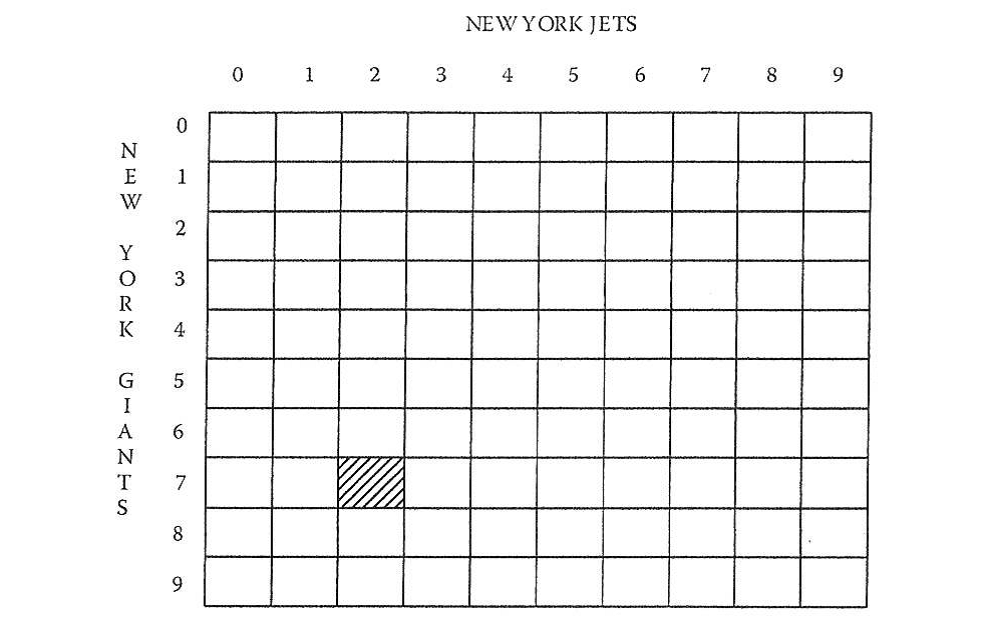
One of the major gambling options during this period is to “buy a box” in a uniquely arranged square, usually referred to as the pool. An example of a pool is shown in Figure 1 for a Giant-Jet game. As can be seen, there are 100 boxes. If each box costs $1,000, the total cash pool is $100,000. The individual, who correctly selects the box with the last digit of the final score for each team takes home the bacon, i.e., wins the $100,000. If the final score is Jets 22/Giants 7, the owner of the shaded box is the winner. Scores such as Jets 12/Giants 27 or Jets 22/Giants 37 would also serve as winners for that box.

nonrandom pool
FIGURE 1 Nonrandom pool.
However, employing the format in Figure l does not provide each person buying a box an equal chance of winning. Knowledgeable football fans would immediately realize that the best numbers to select are 0 and 7, whereas the worst are 2, 5, and 6; therefore, the arrangement of the box as in Figure 1 does not provide each bettor with an equal chance to win. This bias can be removed, and the bet reduced to one solely of chance by assigning the numbers to each team in a random manner after individuals have paid and selected a box. The procedure most often used is to write numbers from 0 to 9 (each) on a piece of paper. The 10 pieces of paper are then randomly drawn from a container and sequentially placed along the side of the square – first horizontally and then vertically. The result might look like Figure 2. Had the same box been selected (see Figure 2), the bettor’s last team digits would be Giants 2/Jets 0. A final score of Giants 42/Jets 30 would be a winner as would Giants 12/Jets 20.
random pool
FIGURE 2 Random pool.

Many gambling activities are available and legal in the U.S. However, the above form of gambling is not legal although it is practiced in private clubs, bars, parties and homes. For example, the football boxes have become an integral part of an annual party that I host at our home for the Killeen’s Tavern basketball team of yesteryear. One of the keys in this betting venture is to ensure that the individual running the box activity does it in a manner that is fair and that the odds are not heavily weighted in favor of the “concessionaire.” Generally, 5 to 10% of the total pool is considered reasonable compensation or takeout for running this illegal business/gambling activity. For whatever it’s worth, there is no takeout at our party, i.e., all of the money is returned to the winners.

The topic of March Madness invariably arises in any discussion of this form of gambling. The NCAA Men’s Division 1 Basketball Championship, or March Madness, is a single-elimination tournament – known as the Big Dance – held each spring and features 68 college basketball teams battling to determine the national championship. The box activity has recently worked its way into this sports venue. And, believe this or not, but the box activity is also part of the gambling that takes place with the World Series. Once again, it is the last digit of the final score of the game. Thus, the key box numbers for a winning final score of 11-3 are 1, 3.

Good luck to those of you who participate in the football box pool this month and beyond.

It’s also that time of the year. Merry Christmas, Happy Holidays, and Happy New Year to the newsletter readers.

Lou Theodore

NEXT POSTINGS: (tentative)

FEBRUARY 1: On Great Eats
MARCH 1: On the SATS
APRIL 1: On Paying Student – Athletes III
MAY 1: On School Taxes


Barack Hussein Obama Update IV

October 1, 2014

October 1, 2014

It’s time for another BHO article. As many in the reading audience know, I have repeatedly claimed (and believe could prove in a court of law) that BHO is

1. a liar
2. dumb
3. lazy
4. corrupt
5. un-American
6. an egomaniac
7. nasty and arrogant

I’ve listed three dozen of BHO’s activities since the last article in the April 2014 newsletter. Once again, the reader is encouraged to assign the appropriate number above to each activity.

1. Continues to tell the public that he is beholden to no one, including you and me.
2. Has become a habitual loafer.
3. Played golf and had a jolly old time immediately following a ISIS beheading incident.
4. Continues to wage class warfare between the rich and poor, young and old, sick and healthy, white and black, educated and uneducated, etc.
5. Regularly is without and/or lacking a plan, purpose, policy, preparation, etc.
6. Responses to critical issues have been laughable.
7. Continues to place our nation deeper into debt.
8. He is not a student of geography, a characteristic of dumb people.
9. He is not a student of history, a characteristic of dumb people.
10. Has attempted to rewrite the history of our nation.
11. Continues to impose repressive legislation and rules that has hampered the development of business.
12. Continues to refuse to accept the greatness of this nation.
13. He is a coward who has refused to accept that war, i.e., the necessity of war, is sometimes necessary and inevitable. Hello Neville Chamberlain.
14. Has poisoned part of our nation with his disloyalty.
15. Refused to accept that there is an international terrorist threat.
16. Improperly decided to take action on one shooting in Ferguson for which he had no facts.
17. Has refused to take action on the documented, round-the-clock murder of hundreds of young blacks in Chicago, yet got involved with the killing of a young black in Ferguson, MO.
18.
19. Stood by quietly as fellow-racist Eric Holder expressed sympathy and understanding for those rioting, shooting and looting in Ferguson.
20. Refuses to hold his appointees responsible for any wrongdoings.
21. Continues to use the government for political and personal purposes.
22. Refuses to accept that duties supersede all personal and ideological considerations.
23. Has never commented on his failure to honor the promise to “get to the bottom of this problem….” 8 TIMES. 8 TIMES!!!
24. Has refused to sympathize with whistle-blowers.
25. Has effectively claimed (with a straight face) that he knew nothing about the IRS, Benghazi, Fast and Furious, etc.
26. Never explained what happened with his “red line.”
27. Never retracted his initial Benghazi statement that it “was a spontaneous riot about a movie.”
28. Never retracted his promises on Obamacare, i.e., premiums will be lowered, you can keep your doctor, it will be a simple process, etc.
29. Is more concerned about healthcare for terrorists, prisoners, illegals, and those unwilling to work than for our veterans.
30. Has never really explained his failed foreign policy with respect to ISIS, immigration, Putin, North Korea, China’s excursions, al Qaeda, veteran services, etc.
31. Continues to change things in our government.
32. Has forgotten this statement: “I, Barack Hussein Obama, pledge to preserve, protect and defend the Constitution of the United States of America…so help me God.”
33. He has successfully divided our nation and united our enemies.
34. Due to BHO’s position on foreign policy, energy, jobs, health care, etc., our nation is indeed in decline.
35. BHO is now into fundraisers and golf – wisely no longer lecturing us on his great accomplishment. Remember his dozens of speeches on Obamacare?
36. BHO blew it in Iraq (another idiotic decision) since the war was won and the country was well on its way toward a democracy – something that would have devastated our enemies in the Middle East.
37. Claimed to Bill O’Reilly that “there isn’t a smidgen of evidence that the IRS acted improperly,” even through his appointee Lois Lerner refused to testify.

I need to further address the events that have transpired in Ferguson. The rioting, looting and unlawful conduct following the shooting of the black man lasted two weeks. At no time did BHO and/or Eric Holder condemn this behavior by these criminals/misguided individuals. Why no comment from these two? It’s simple – both are racists. Why no condemnation by the liberal media? It’s simple — they are all corrupt and a disgrace to their profession.

Of course, there is still “I will put an end to conduct that breeds division, conflict, and cynicism”, “will bridge the gap between black and white”, “will have the most transparent administration in history”, and “will restore trust in Government.”

At this point in time, our nation is ruled by a lawless administration headed by a corrupt, lazy, lying un-American, and potentially crazed individual that has refused to be accountable to the electorate. The pressure and criticism the president is experiencing is justifiable but his ego is coming to the forefront, which may lead to disastrous results in the future. I say this because I believe our country is being run by an irresponsible uncontrollable committee consisting of really dumb people.

I will return next year with BHO V. I dread to think what else can transpire in the coming months with the idiot at the helm. Note: Some would argue that it is inappropriate and improper to call our President dumb and an idiot but remember this is the same guy who kept telling the world that he claimed he knew more than his speech writers, advisers, experts, etc., and is “focused like a laser on creating jobs.”

Lou Theodore

NEXT POSTINGS: (tentative)

NOVEMBER 1: On Paying Student-Athletes II
DECEMBER 1: On Hofstra Men’s Basketball: 2014-15 Season
JANUARY 1: On Football Boxes
FEBRUARY 1: On Great Eats


On a National Energy Policy

August 1, 2014

August 1, 2014
What about the need to develop a meaningful and comprehensive national energy policy that addresses all energy-related concerns and is also dynamic enough to last into the future? Although some will claim that an energy policy is already in place and being implemented, this statement is based on a host of state initiatives (New York State is but one example) that effectively keys on conservation and attempts to move the nation from a coal economy to a natural gas economy. Unfortunately, these policies vary from state to state, sometimes from region to region within a state, and from industry to industry. Perhaps the main objective of these policies is to reduce and/or eliminate carbon dioxide (CO2) discharges into the atmosphere from fossil fuel conversion processes. And, because of these questionable environmental concerns, the importance of maximizing the economic well-being of the nation has been essentially totally ignored.

This year, I published a book entitled “energy Resources: Availability, Management, and Environmental Impacts,” ISBN#978-1-4665-1740-0. It was coauthored with Ken Skipka, Principal at RTP Environmental Associates, Inc. in Westbury, and published by CRC Press/Taylor & Francis Group. The main thrust of the book is to not only detail the need for a national energy policy but also propose a policy that would reduce/eliminate current energy problems. What specifically is needed is an unbiased assessment of the energy resources of the nation, the current and future demands, multimedia impacts associated with that demand–including conversion processes and its distribution, the socioeconomic costs and benefits of available alternatives, maximizing economic profits from energy resources, and the multimedia residuals that are part of the energy cycle. And only this type of analysis will provide the best approach to achieving energy independence. So, yes, there definitely is a need to propose and implement a true national energy policy as opposed to the disjointed and disruptive policies of option scatter diagrams of yesterday and today. What follows is material adapted from our book.

Energy is the keystone of life and prosperity. Adequate energy supplies and a satisfactory living environment are goals of overriding importance to every individual. There is no question that as energy is made available, the quality of life improves. In addition to the need for a constant and adequate supply of energy in both the near term and the future, environmental, economic, and national stability must also be maintained. Recent developments provide evidence that the discourse on all of these aspects will continue and be the prime determinants of domestic and foreign policy for many years to come.

Over the past 40+ years, there has arisen among informed leaders of indus¬try, governments, and the environmental movement an acute awareness of energy as an issue of critical importance to everyone’s well-being and sur¬vival. An energy crisis–or problem, or dilemma, as it has been called – was created by the continually increasing demand for energy at the international level. This demand has resulted in the three aforementioned issues becoming critical concerns of the entire international community, i.e.
1. The adequate, reliable supply of all forms of energy.
2. The environmental con¬sequences of producing energy.
3. The social ramifications associated with the accompanying financial expenditures and/or profits associated with meeting the energy demand.
To complicate matters, these three issues are also interrelated.

The solutions to the problems that arise from energy demand may simply be conservation and the development of new, less expensive energy forms. Energy conservation can sharply reduce the waste of resources that has been at the very heart of many environmental problems. Moreover, an extensive conservation program can be implemented in a very short period of time. Such an effort can play a major role both in slowing the growth in the demand for energy and in causing energy to be used more efficiently. At the same time, new sources of energy must be developed to ensure the availability of adequate, inexpensive, long-term energy supplies. The commercialization of solar power, wind, tidal, geothermal, fusion, and other less traditional sources of energy must continue to be investigated and expanded.

The facts on present-day energy consumption are universally accepted. Even the projections for the raw material reserves of oil, coal, gas, and uranium cause little argument. But, consensus on all other aspects of energy policy is essentially non-existent. In the broadest sense, many cannot agree whether there is presently a crisis or a problem. To better appraise the magnitude of these measures, one must set short-term and long-term goals, both of which are discussed next.

It is critical that short-term conservation steps be initiated. But the United States also needs a long-term policy ….. now. A comprehensive coordinated national energy policy must be formulated and implemented in a fair and equitable manner. This policy should be subject to continuing review and adjusted to address such needs as depleting resources, new technological breakthroughs, the aforementioned conservation measures, etc. In short, the policy should cover the following (baker’s dozen) categories:
1. Set up a comprehensive cabinet-level agency dealing with all forms of energy.
2. Systematize and refine air and water pollution guidelines, and estab¬lish land utilization policies to ease the siting of refineries, power plants, and petrochemical operations.
3. Stimulate increases in domestic oil and gas production by deregulat¬ing gas prices or regulating them with realistic price guidelines.
4. Stimulate increases in domestic oil and gas production by increasing the size of offshore leases as well as the frequency of lease sales.
5. Change guidelines to favor exploration in the U.S. rather than favoring international exploration and pro¬duction abroad by allowing royalties paid to foreign governments to be written off against federal tax owed the U.S. government.
6. Foster research on improved coal mining and new reclamation techniques.
7. Sponsor, fund, and encourage coal gasification projects to a degree that would lead to possible commercialization of the process within this and the next decade.
8. Foster additional research on alternative energy sources (solar, nuclear, tidal, wind, biofuel, and geothermal energy).
9. Provide regulations and/or incentives to allow the use of coal as a petroleum substitute in certain industrial operations.
10. Accelerate and systematize the environmental review process of proposed energy projects.
11. Coordinate all energy research to take advantage of breakthrough technologies with the end goal of not only becoming energy independent but also optimizing economic benefits.
12. Foster additional research on the environmental problems involved in the production of nuclear energy.
13. Analyze and implement the aforementioned energy conservation measures whenever such a need arises.

Many years ago, during my professional career, I developed a calculational procedure for allowing a technical individual to quantify a decision-requiring process that is a function of numerous, difficult to evaluate variables. This procedure was applied to three applications: fly ash control options for coal-fired utility boilers, pollution prevention options, and wastewater sludge management. The application of this procedure to energy resources is described in the book for the U.S., developed countries, and underdeveloped countries. The purpose of these analyses is to provide quantitative information that might allow one to select what one could describe as the “optimum” energy policy.

The above procedure was applied to the following energy resource categories:

Coal
Oil
Natural gas
Shale
Tar sands
Solar
Nuclear (fusion)
Hydroelectric
Wind
Geothermal
Hydrogen
Bioenergy
Other

Each of these categories were evaluated relative to the following parameters:

Resource quantity (RQ) 8
Resource availability (RA) 8
Energy quality (EQ) 5
Economics concerns (EC) 7
Conversion requirements (CR) 3
Transportation requirements (TR) 3
Delivery requirements (DR) 3
Operation and maintenance (OM) 2
Regulatory issues (RI) 7
Environmental concerns (EN) 6
Consumer experience (CE) 4
Public acceptance (PA) 4

Weighting factors (within the number range of 1-10) were assigned to each of the above parameters. This magnitude depends on the significance or importance attached to each parameter. Because the relative importance of the parameter under study can change from month to month or from year to year or location to location, and because parameters must often be added or deleted, these weighting factors should be periodically updated and adjusted for continuous use of this type of analysis for a specific parameter.

At the heart of the matter is the quantitative analysis of energy management options, a main impetus for writing the aforementioned book. An outline of the methods of quantitative analysis was briefly discussed in the preceding paragraph. Establishing a decision-driven process with quantitative results will allow the appropriate evaluation and weighting of the numerous variables that are part of every management system. Extensive details on this evaluation process are provided in our book.

One cannot conduct or manage any system, including a national energy policy, without a full understanding of the various roles to be played by the individuals involved. As many are aware, the best intentions often lead to disappointment because of one or more individuals not completing their roles as planned. To be successful, an energy policy must be able to identify the individual roles to be played and to assure that all players are committed to the same goal. Recognizing that there will be winners and losers, the ultimate goal will be to design the policy as a win-win proposition by applying incentives to allow a smooth transition as the energy management policy evolves. This process is intended to be in contrast to standard intense competitions that are the norm for today’s societal and individual interactions. Unless there is cooperation, the best policy plans can be easily undermined. In an attempt to address this issue, the roles of the major players was discussed in the book; this dictated having each individual responsible for the consequences of his or her actions and for the cost of correcting the undesirable consequences of these actions. Although these goals appear to be out of the current grasp of many, several active programs are, in fact, already in place to perform these exact functions.

What good should come from an effective national energy policy? First, one should recognize that without a properly designed and executed policy, the difficulties experienced in recent years, particularly those associated with environmental concerns, will continue and almost certainly escalate. The challenges going forward appear to be even more difficult as certain energy resources become scarcer, the possibility that the theorized impacts of climate change are proven, and developing countries desire the benefits gained by the problems of abundant energy. Sustainability will ultimately not be possible because of these considerations but nations should continue to strive for sustainability as long as possible. By delaying policy development, other potential solutions to energy independence will not be aggressively researched and implemented, thereby causing disruptions of current and future energy supplies and strains on socioeconomics.

In the final analysis, the goal of a national energy policy must be to develop and apply energy resources in a manner that is protective of the environment, services the energy needs of industry and society, is economically viable, and is defensible from a cost-effective perspective. Such a policy is needed because the current approach of haphazardly jumping from one energy form to another, blind to the various consequences, has proven to be both very costly, resulting in a continually changing course of action. For example, just a few years ago, the phase “peak oil” was popular while today, the maximum utilization of natural gas resources for energy production and the “ditching” of coal is the stated goal without really analyzing all costs/benefits associated with this massive displacement in direction. Many energy policies in the past have been prepared typically to serve the current interests of those in control. Rarely, if ever, have energy policies taken a truly unbiased approach to evaluating available and potential resources and formulating an effective dynamic set of policy objectives that focus on a goal of energy abundance, independence, sustainability, economic benefit and environmental preservation.

It’s time to take action!

Lou Theodore

NEXT POSTINGS: (tentative)

SEPTEMBER 1: On Purely Chaste, Pristine and Random Thoughts XXI
OCTOBER 1: On Barack Hussein Obama Update IV
NOVEMBER 1: On Paying Student-Athletes II
DECEMBER 1: On Hofstra Men’s Basketball: 2014-15 Season
JANUARY 1: On Football Boxes
FEBRUARY 1: On Great Eats


On Tenure

June 21, 2014

July 1, 2014

The word tenure has come to mean different things to different people at various points in time in the history of civilization. A thousand years ago, tenure related to the law of property in feudal England and the manner in which a person held or owned property. Under feudalism, the king owned all of the land, and his vassals, as tenants, were entitled to hold only those portions of the land allotted by him and only under conditions he imposed. This feudal control by the overlord of transfers of property by tenants, was ended in 1290 by the Statute of Quia Emplores. In recent years, tenure has taken on a different meaning for many people, particularly those in education. Webster presently defines tenure as “the status of holding one’s position on a permanent basis, granted to teachers, civil servant personnel, etc., on the fulfillment of specified requirements.”

This article examines the role and the effect tenure has had on both educators and the education process. Unfortunately, for some teachers – and perhaps more rather than some for teachers at the East Williston School District – tenure has come to represent a job with no accountability.

I’m a chemical engineer and proud of it. I practiced my trade primarily in the classroom for 50 years. Educating youngsters for a career in engineering and training engineers/scientists in order to enhance their careers became my signature professional purpose. I did this in part because I believe engineering, more than any other profession, has contributed significantly to improving the quality of life for society. Along the way, I was tenured for the last 43 years.

My experiences as a tenured faculty member at my institution were interesting. Most of my colleagues were reasonably dedicated and rarely missed class, but I would describe only a few as hardworking. For what it’s worth, I missed one day (in the hospital) in 50 years. Overall, most of my guys did an acceptable job. But there were some, perhaps one out of every five, who milked the system for their own aggrandizement at the expense of the students. And nearly every one of those extortive individuals viewed themselves as God’s gift to education.

The situation at the EWSD is particularly disconcerting. The Board, PTO, and Superintendent have chosen not to allow opposing voices to be heard. FOIL requests are routinely effectively ignored (they once responded to one of my FOILS by providing me with reams of paper that were impossible to decipher). Some parents are too frightened to speak out, as with the teacher who retaliated against a 6-year old because her mother had the courage to speak the truth. It is for this reason that I always advise parents who have considered speaking out to remain anonymous. I have repeatedly made the above claims, and yet, no one – including the PTO hierarchy and the Superintendent – have ever dared to challenge my accusations. The FACT that the Superintendent misrepresented herself on the application for the position has also never been challenged.

What do we have at the EWSD? Based on my information, most of the EWSD teachers, and particularly those at Wheatley High School, approach their job as teachers in a manner quite different from what I would describe as a dedicated educator. The end result has been a precipitous drop in the school’s ranking, significant absenteeism, a failure of some (or is it many?) students to be admitted into the college/university of their choice, and poor student writing skills. Why is this occurring? I have placed the blame on numerous occasions on the incompetent past School Board President, Susan Bergtraum, and the former parasitic School Union President, David Israel (I still have a copy of the contract where Israel sold his membership short in order to gain a personal giveaway from the District). They set a process in motion that has resulted in the decline of quality education and teacher abuse in the EWSD.

Although much of the above will be viewed by the enemy as rhetoric, one needs to examine teachers’ salaries relative to others. As with some other professions, e.g., medicine, I believe it is disproportionate relative to the rest of the work force. Present-day salaries simply cannot be justified, particularly for those whose salaries are at $150,000/year. When one considers the salary, perks, health benefits, abbreviated workdays, extensive vacation periods, work ethics, etc., of the suburban teacher, it is hard not to conclude that these individuals have it made. Make no mistake about it, they have it made! I ought to know, because I was part of a similar system – only at another level.

And then there is job security. Today, most taxpayers no longer have the luxury of job security. In the old days, one might receive at any time a DCM – as it was called curing the depression era – Don’t Come Monday. Being tenured means not having to worry about losing your job. What is this worth? When I was growing up, it was worth enough that teachers who earned significantly less than the rest of the workforce were grateful for their job. I knew when I accepted a teaching position in 1960 for $6,000 a year, a salary substantially below what my colleagues were accepting in industry and business, I did so for two reasons: the desire to teach and the benefits mentioned above.

The bottom line is that tenure has unquestionably produced tenured teachers who are pampered, underworked, overpaid, lazy and indifferent to the needs of their students. All of them? NO! But many of them? YES! The tenure process has led to the aforementioned disproportionate wages and benefits relative to the rest of the workforce plus a lifetime of job security. As I’ve said on numerous occasions: we teachers have jobs, the rest work for a living.

Will tenure survive in its present form? I doubt it. Nor should it. The Ivy schools have all but eliminated tenure. I can say in no uncertain terms that tenure was appreciated and probably helped me from an academic and professional perspective. But the abuses that I witnessed and the present abuses at places like the EWSD need to be reduced, if not eliminated. There needs to be accountability if the educational process is to return to what we had in earlier times. Perhaps five-year tenure appointments with periodic evaluations might help.

For tenured teachers, it is time to give thanks. It is also time to reverse the trend and provide tax relief and start putting money into scholastic programs, not teachers’ salaries. For the tenured teachers, it is payback time.

Lou Theodore

PREVIOUS POSTINGS:
APRIL 1: On the Barack Hussein Obama Update III
MAY 1: On the East Williston School District Budget Vote
JUNE 1: On the Interview Process
JULY 1: On Tenure

NEXT POSTINGS (tentative):
AUGUST 1: On a National Energy Policy
SEPTEMBER 1: On Purely Chaste, Pristine and Random Thoughts XXI
OCTOBER 1: On Barack Hussein Obama Update IV
NOVEMBER 1: On Paying Student-Athletes II
DECEMBER 1: On Hofstra Men’s Basketball: 2014-15 Season
JANUARY 1: On Football Boxes
FEBRUARY 1: On Great Eats