ON BOXES

June 1, 2024

June 1, 2024

Traditional gambling generally refers to the wagering of money on a yet-to-be determined event or outcome that may be dependent on either chance or skill, or both. Casino roulette is a game of chance, while poker is primarily a game of skill. Gambling on athletic sporting events, such as football, basketball, baseball, etc., is generally viewed as involving both skill and chance. On to “boxes,” the title of this article, which are strictly a game of chance.

One of the major sports gambling options is to buy a “box” in a uniquely arranged square, usually referred to as the pool. An example of a pool is shown in Figure 1 for a Giant-Jet football game. As can be seen, there are 100 boxes. If each box costs $10, the total cash pool is $1,000. The individual who correctly selects the box with the last digit of the final score for each team takes home the bacon, i.e., wins the $1,000. If the final score is Jets 22/Giants 7, the owner of the shaded box is the winner. Scores, such as Jets 12/Giants 2, or Jets 22/Giants 37, would also serve as winners for that box.

             N E W    Y O R K     J E T S
N
E
W

Y
O
R
K
 
G
I
A
N
T
S
 0123456789 
0           
1           
2           
3           
4           
5           
6           
7           
8           
9           

      Figure 1: Sample Box

However, employing the format in Figure 1 does not provide each person buying a box with an equal chance of winning. Knowledgeable football fans would immediately realize that the best numbers to select in a football pool are 0 and 7, whereas the worst are 2, 5, and 8; therefore, the arrangement of the boxes as in Figure 1 does not provide each bettor with an equal chance to win. This bias can be removed, and the bet reduced to one solely of chance by assigning the numbers to each team in a random manner after individuals have paid and selected a box. The bias-removing procedure most often used is to write numbers from 0 to 9 (each) on a piece of paper. The 10 pieces of paper are then randomly drawn from a container and sequentially placed along the side of the square – first horizontally and then vertically. The result might look like Figure 2. Had the same box been selected earlier (see Figure 1), the bettor’s last team winning digits would be Giants 2/Jets 0, i.e., 2,0. A final score of Giants 42/Jets 30 would be a winner as would Giants 12/Jets 20.

  Figure 2: Sample Betting Box

              N E W     Y O R K     J E T S
N
E
W

Y
O
R
K

G
I
A
N
T
S
 2309817564 
8           
0           
3           
4           
6           
1           
5           
2           
7           
9           

Many gambling activities are available and legal in the U.S. However, the above form of gambling is not legal, although it is regularly practiced in private clubs, bars, parties, and homes with $ replaced by peanuts (or the equivalent) to legitimatize the activity. For example, the football boxes became an integral part of an annual party that I hosted at our home for the legendary Astoria Killeen’s Tavern basketball team of yesteryear (see also Basketball Coaching 101 by L. Theodore). One of the keys in this betting venture is to ensure that the individual running the box activity does it in a manner that is fair and that the odds are not heavily weighted in favor of the “concessionaire.” Generally, 5 to 10% of the total pool is considered reasonable compensation or takeout for running this “illegal” business / gambling activity. For whatever it’s worth, there was no takeout at our party, i.e., all of the money was returned to the winner.

The box activity has recently worked its way into other sports venues. And, believe this or not, the box activity is also part (recently) of gambling that takes place with the World Series. It’s just a matter of time before it works its way into all sports venues, and then onto casinos. Once again, it is the last digit of the final score of the game for each team that counts. Thus, the key box numbers for a winning final score of 20-3 is 0, 3.

What prompted the writing of this article? The Boy, the Queen and your favorite author recently shared one $10 box on the recent Superbowl at the Boy’s firehouse with the numbers 5 (KC) and 2 (SF). Remember my earlier comment that 2 and 5 are the worst numbers to draw in a football box investment. However, the final score was 25 (KC) and 22 (SF) and we wound up sharing $350.

In any event, football boxes are now commonplace. Now comes the main theme for this article – my thoughts on boxes for the future on other sports. I believe that boxes will soon be available on both basketball (both pros and college) and baseball (pros). Table 1 below provides my suggestions that includes (a) time interval, and (b) award split, based on a pool of $1,000. TBD refers to To Be Determined.

BASKETS:BASEBALL:
(I)(II)             (III)(IV)
ProsCollegesPros
(a) Quarter(b) Award(a) Quarter(b) Award(a)          Min(b) Award(a)         Inning(b) Award
 1/4100102004th200
 1/2200 1/24002020016th200
 3/4200302008th200
Final400Final400Final4009th400
OvertimeTBDOTTBDOTTBDExtraTBD

                                                             Table 1: Futuristic Boxes 

  Note that the awards can be adjusted, e.g., the entire award could be based on the final score.

Note that there are four potential box options: Three (I-III) for basketball and one for baseball (IV). Here are some explanatory details: For (I), if the score after a quarter is 32-20, the winning numbers would be 2-0 with a $200 award. For II, if the halftime score is 48-45, the winning numbers would be 8-5 with a $400 award. For III, if the score after 30 minutes is 66-65, the winning numbers would be 6-5 with a $200 award. For IV, if the runs (R) hits (H) and errors (E) after 6 innings total 11 for one team and 7 for the other team, the winning numbers would be 1-7 with a $200 award. Note that both the quarters, minutes, and RHE can be changed, as well as the award / prize.

Folks, I’m fairly certain that it’s just a matter of time before “boxes” will become part of the betting venue at sportsbooks.

That’s it. What do you think? I’d love to hear from you!

Visit the author at:

www.theodorenewsletter.com

and / or

Basketball Coaching 101 on Facebook

NEXT POSTINGS

JULY 1:                      On Purely Random, Pristine Thoughts XXXVII

AUGUST 1:                One Sleep Apnea II

SEPTEMBER 1:         On Vertigo

NOVEMBER 1:         On Hello Basketball, Goodbye Baseball


HELLO BASEBALL, GOODBYE BASKETBALL

May 1, 2024

May 1, 2024

It’s transition time, i.e., time to leave basketball and move on to baseball. Both are important to many of us since sportsbooks have now become front and center for the betting public. For me, it’s DraftKings. For others, it’s FanDuel. In any event, here’s how basketball came down for me and what’s coming up with baseball.

BASKETBALL: Another good year. You might remember that I had the University of Connecticut (UCONN) last year at 40-1. My key bet this year was Illinois, basically because I felt their guard Shannon was the best player in college basketball. However, they got knocked off the elite 8 by UCONN. However, my second bet was on UCONN. In my recent book Winning at Casinos: The Definitive Edge (Amazon, 9$) book, I warned against betting on repeaters. Sorry, but this UCONN group was a different team; I loved the way the team played and performed. I also had a host of other bets including Yale at 1,000-1 to make the final four, North Carolina State at 50-1 to win it all, etc., etc.

BASEBALL: I got hurt last year. My key bet at the start of the season was with the BALTIMORE ORIOLES, and believe it or not, I wound up losing money on them. Don’t ask me how, but I just screwed up with all the betting options now available (See end of article).

But that was then and now is now…and it’s now that counts. I spread this year, with five key bets.

  1. METS (World Series). Ugh!!!
  2. PIRATES (WS and National League)
  3. TORONTO (WS and American League)
  4. CLEVELAND (AL and over)
  5. BOSTON(AL)

I also went partners with the dearest of old friends in Clearwater Beach, FL on the Yankees (WS) and (AL). I’m not happy about his bet, but it looks good so far.

You will note that I stayed away from the DODGERS, BRAVES and the repeater TEXAS. I’m giving some thoughts to four other bets.

  1. KANSAS CITY
  2. SAN DIEGO
  3. ANGELS
  4. PHILADELPHIA

I’ll probably wind-up betting two of them – probably the first two – between now and the All-Star break. You will also note that all of the bets are long shots.

Keep in mind that there are primarily two types of bets made  in sports betting. One is the point spread, the other the money line. Each has its place not only in baseball but also football, basketball soccer, and hockey. And, sports bets can be made on either a Smartphone or Internet. I’m sure you have seen all the advertisements on television regarding offers such as those provided by DraftKings, FanDuel, etc. It really has become wild.

I’d recommend future bets (I refer to them as seasonal bets). These are bets on a team winning a championship or a league or a division, etc. I find this a particularly attractive bet since it involves only one bet that will (hopefully) apply over the entire season. The odds here are a very, strong function of time since the performance of your team almost always varies during the season.

Good luck this season.

P.S. This is the month for voting on school taxes and school board members for many of the readers who reside in Nassau County. I suggest getting involved and vote AGAINST the proposed school taxes.

Visit the author at:

www.theodorenewsletter.com

and / or

Basketball Coaching 101 @ Facebook

NEXT POSTINGS

JUNE 1:                      On Boxes

JULY 1:                      On Purely Random, Pristine Thoughts XXXVII

AUGUST 1:                On Sleep Apnea II

SEPTEMBER 1:         On Vertigo

OCTOBER:                 On the Ultimate Questionnaire

NOVEMBER 1:         On Hello Basketball, Goodbye Baseball

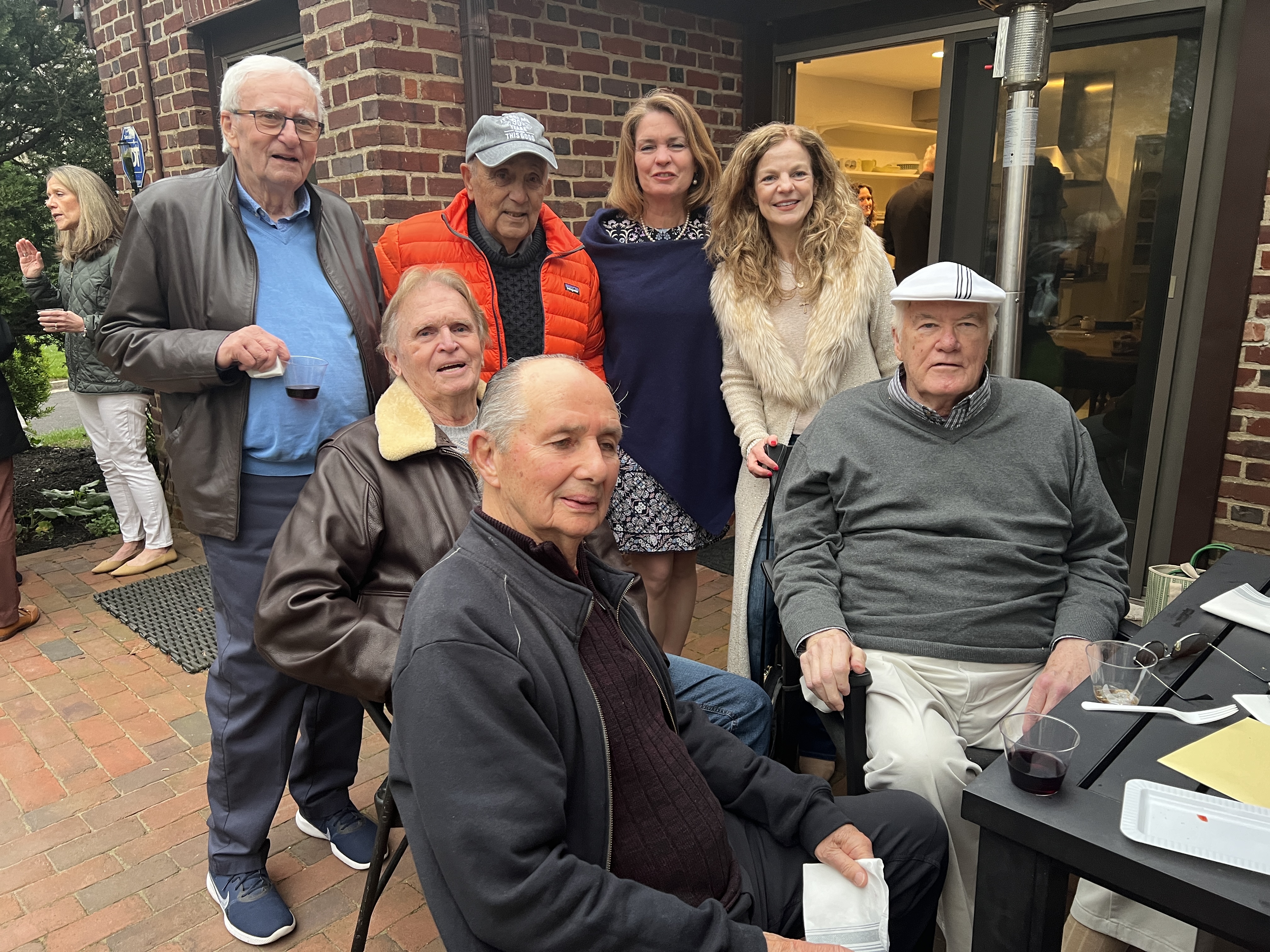
The family celebrated my 90th birthday this past April 19th. It’s hard to believe that I’ve been around nearly a century. The remnants of the Killeen’s Tavern legendary basketball team of the 1950s and 60s in Astoria, Queens, are pictured below. The gala event was hosted by Mary and our daughters, Georgeen and Molleen, along with our son, Patrick, and was attended by 83 friends, former students, neighbors and relatives. The menu featured a charcuterie board, colossal shrimp, lollipop rib lamb chops, Caesar salad, along with a traditional Greek menu of spanakopita, lemon potatoes, grilled veggies, moussaka, and pastitsio. Dessert was homemade by our daughters and included baklava, rivani, and brownies.  Birthday wishes were sung, and candles were blow out over a Carvel ice cream cake.

Left to right: Dan (The Dan) Corenza, Jim (JR) Raffetery- 1964 Haggerty Award for the Most Outstanding College Basketball Player in the Metropolitan area, Frankie Quarto – 4-year starting guard at Manhattan College, and Danny (Big Dan) Doyle – Detroit Pistons, 1961-3. Included in the picture are your favorite basketball coach alongside Bonnie Parente, East Williston mayor and Jennifer DeSena, Town of North Hempstead Supervisor.


ON TECHNICAL WRITING

April 1, 2024

April 1, 2024

I once humorously offered this comment to my students: “either you’re from Harvard and can’t count or from MIT and can’t write”.  The comment was made to introduce the difference between non-technical writing and technical writing.

Well, what about the difference? The non-technical and technical material are written in contrasting styles. Technical pieces are written in a factual, ‘dry’ style, emphasizing quantitative analysis, whereas the non-technical passages contain numerous adjectives and modifiers. Similarly, engineering texts I’ve written, (149) have one thing in common: they contain a minimum of pictures and graphs, usually in black and white. Non-technical texts, by contrast, contain numerous color pictures and graphics. The contrast in style between the two is reminiscent of the contrast between a black and white “how to” video, and a high-budget movie. Naturally, the engineering texts use a pragmatic and mechanistic approach, while the non-technical books have a philosophical bent, or what I define as the liberal arts approach. Further, one generally transmits information while the other entertains. In any event, this article is concerned with technical writing, a topic that should be of interest to many of the readers.

Technical writing really isn’t that difficult; it is NOT a talent that only a handful of people are born with. With that in mind, here are a few basic rules (a baker’s dozen) that can transform one’s writing from a confusing, garbled mess into something that will impress readers.

  1. If applicable, know thy reader(s).
  2. It helps if the subject has not been written about before. If it has, improve what is available by editing, rewriting, expanding, and updating. There should also be an element of interest to the reader(s).
  3. Prepare an outline. This should include an appropriate title, objective(s), introduction, background, results, conclusion(s), and recommendations(s).
  4. Improve the foundation of the outline by filling it in with notes and sentences.
  5. Keep related ideas together and establish a logical flow from paragraph to paragraph and section to section.
  6. The abstract or executive summary (for technical reports) is the most important part of the writing. Spend a significant amount of time here. It is the only material that is read by the majority of the readers. The reader (perhaps your immediate supervisor) can then decide whether to go deeper into the writing. This is very important: the abstract should contain a brief summary of the report without referring to the main body of the report.
  7. Sentences should contain little to no unnecessary words; paragraphs should contain little to no unnecessary sentences. One certainly would have no unnecessary lines in a diagram or unnecessary parts in a machine.
  8. The swan song of the successful writer is: revision, revision, revision. Start early, e.g., weeks before it is due and / or submitted. Get colleagues, friends, your wife (my usual option), to review and critique your material.
  9. If your “report” is a resume, make sure it is current. Be prepared to tailor your resume to the individual reviewing it. And, don’t be bashful. I often refer to myself as “the foremost environmental authority in the world.”
  10. If there is a Table of Contents, list every section title and heading starting with page 1, not page I, and give the number of the page on which it appears.
  11. If there is a Statistical Error Analysis, it must be written with opening and closing paragraphs. It should include theoretical equations along with written explanations, and conclude with a discussion of the numerical values determined from the error analysis.
  12. Conclusions and recommendations (if required) are just that. It is generally written as an extended paragraph even though it is often a series of loosely related topic sentences.
  13. References may be required. Footnotes are not commonly used in technical literature. All of the references cited in the report must be listed at the end of the report and (my preference) in the order of their appearance.

I hope this helps. In the final analysis, the more one reads and writes, the easier it becomes. It is like tying shoes or riding a bike; it’s a little hard at first, but once mastered it will never leave you.

Visit the author at:

www.theodorenewsletter.com

and / or

Basketball Coaching 101 on Facebook

NEXT POSTINGS

MAY 1;                      On Hello Baseball and Goodbye Basketball

JUNE 1:                      On Purely Random, Pristine Thoughts XXXVII

JULY 1:                      On Boxes


A HAPHAZARD BIDEN CHRONICLE

March 1, 2024

March 1, 2024

It’s been nearly two years!  ?*#?  Well, not quite.

It’s time for a political article. Afterall, I haven’t addressed anything of a political nature for over a year. I’ve really been a good boy, trying my best not to offend my family, readers, and editors.

What could I write about that is timely and not offensive? After some deliberation, I decided to talk about President Joe Biden. This one might be OK since Biden, understandably, continues to lose favor with the American public. So, what did I do? I raided my Biden files and here are some haphazard one-liners from my disjointed notes.

  • Shut down the Keystone pipeline leaving us without energy security.
  • Opened borders and welcomed all immigrants; as now reversed policy and blamed problems on others.
  • Lifted sanctions on Russia’s pipeline.
  • China continues to threaten Taiwan.
  • Refused to support police.
  • Later claimed he supported police.
  • Inflation now out of control.
  • Three massive giveaway programs, resulting in skyrocketing debt.
  • Continues to blame others… like me, for the country’s woes.
  • Widespread violence on streets.
  • Supported sanctuary cities and states.
  • Unrelentless attacks on Trump.
  • Ignores (lying) Hunter’s activities.
  • Fostered eliminating parental control.
  • Free speech is no longer free.
  • Encouraged DOJ biased conduct.
  • Encouraged FBI biased conduct.
  • Did nothing to stop the conduct of a biased media.
  • Did nothing to stop the obstructionist activities of Pelosi.
  • Did nothing to stop the reckless expansion of the Federal government.
  • A massive cognitive decline.
  • Was the dumbest elected official prior to his cognitive decline.
  • Spent massive time vacationing and not on presidential duties.
  • The disgrace of Hunter Biden.
  • His criminal activities.
  • His non-stop lying regarding  his criminal activities.
  • Jill Biden has said nothing of Biden’s cognitive decline.
  • The joke of Bidenomics.
  • Widespread media corruption.
  • The uselessness of the Inflation Reduction Act.
  • Unconstitutional act of paying off student loans.
  • The failure of his green energy policy.
  • Ignored Chinese spy balloon.
  • Ignored China’s purchasing land near our defense facilities.
  • Failed to immediately help Ukraine.
  • Failed to immediately help Israel.
  • Failed to act on cyberattacks by Russia.
  • Probability of WWIII is greater than it’s ever been.
  • Probability of a nuclear war is greater than it’s ever been.
  • Allowing China to continue raiding our intellectual properties.
  • The reporting of Musk’s takeover of Twitter!!
  • All our allies appear fearful of our evil enemies.
  • We also appear to be fearful of our evil enemies.
  • We simply are no longer safe.
  • Supports future abortion legislation to terminate life until birth.
  • The CIA and FBI simply no longer work.
  • The totality of the criminality of the entire Biden family has been dismissed by both government and media.
  • Misused classified information.
  • Migrant crime is out of control.
  • Migrant costs are out of control.
  • Media refuses to report Biden crimes.
  • Trump haters refuse to discuss Biden crimes.
  • Supporting immigrants rather than veterans.

I apologize if I have exaggerated or lied, but it would still be a sad tale if only ½, or even ¼, of the tales are true. Kind of sad, wouldn’t you say? And yet, nearly 50% of the electorate would vote for Biden. Sorry, but what does this say about the intellectual mentality of the electorates?

Bottomline:  I think the reader should understand that a democracy cannot exist with a biased media… no ifs, ands, or buts. Also, our form of government cannot go forth with the obstructionist policies that presently exist; Pelosi introduced it and the Republicans have finally adjusted and are doing likewise. Thus, both parties are now voting as a block, and little to nothing is being accomplished. To compound problems, the electorate (for the most part) has little to no knowledge of political, economic, social, health, and scientific matters. Finally, it is important to remember the documented deaths of millions in the Middle East (ISIS and Asia and Taliban) during Obama’s presidency — the end of the senseless deaths and suffering, thanks due to decisive action by Trump — and, the return to the earlier horrors and deaths (along with the Ukraine) currently occurring with Biden. And yet, despite Trump’s humanitarian actions, the Trump Haters still hate him, willing to disregard the deaths, pain, and suffering brought on by Obama’s and Biden’s actions (or is it inactions).

In the meantime, death, unfortunately, continues to visit my former players, friends, and relatives.

Visit the author at:

www.theodorenewsletter.com

and / or

Basketball Coaching 101 on Facebook

NEXT POSTINGS

APRIL 1:                    On Technical Writing

MAY 1;                      On Hello Baseball and Goodbye Basketball

JUNE 1:                      On Purely Random, Pristine Thoughts XXXVII

——————————————————————————————————————–


ON VALENTINE’S DAY

February 1, 2024

February 1, 2024

Valentine’s Day. February 14. It is a day that has come to mean different things to different people.

How about history? The holiday probably derives from an ancient Roman feast where men and maidens drew partners for the coming year by lottery. The festival later became associated with the feast’s day of two Roman martyrs both named St. Valentine; over the years, St. Valentine has, been regarded as the patron saint of lovers. How about history? There are a host of other tales that have appeared in the literature and media. The most plausible tale? Enter Chaucer. At one time in his career, Chaucer claimed it was the first day of Spring with the mating of birds. Other writings followed that began to tie Valentine’s Day with love and affection. Enter Shakespeare. In Hamlet, Ophelia sang a tune that included the lyrics “…and I a maid at your window, to be your Valentine.”

For most, it is a day to exchange notes and / or cards, hopefully written by you… and not Hallmark. For me, it is simply a day to express one’s feeling of care and love for special people.

Fortunately or unfortunately, the day has become commercialized. It is more than just Hallmark cards. It’s gifts that can vary from candy, to jewelry, to flowers etc. (While courting the Queen during the mid-1960s, I remember sending flowers with the note: “just a reminder that the little guy cares. It scored a touchdown.”). In recent years, sweets – particularly chocolates – have come to replace flowers, with the accompanying rip-offs. Sad, but what the hell, it’s only one day a year.

Many, including your favorite author, have extended the premise of this special day to include love of our country. I often give thanks for having been born, raised, and educated in the US of A. Unfortunately, it seems as if more and more people don’t quite have the same feeling I do — but we can only hope I’m wrong.

I need to end on a positive note. I hope everyone in the reading audience has experienced the thrill of falling in love. It is hard to describe. It really is an indescribable feeling, and I will never forget that special period of my life.

Happy Valentine’s Day to All

Visit the author at:

www.theodorenewsletter.com

and / or

Basketball Coaching 101 on Facebook

NEXT POSTINGS

MARCH 1:                 On the Biden Chronicles

APRIL 1:                    On Zzzabuu VI

MAY 1;                      On Technical Writing

JUNE 1:                      On Purely Random, Pristine Thoughts XXXVII

——————————————————————————————————————–


ON “BEGIN THE BEGUINE”

January 1, 2024

January 1, 2024        

This one is about a song. Yes, a song. It’s “Begin the Beguine.”

Let’s start with the word beguine. Webster claims it is a Roman Catholic religious order of sisterhoods founded in the 12th centurywho devoted themselves to charity and good work that included providing refuge for women left widowed or unmarried by the loss of men during the Crusades. But it is also defined as a native dance of the island of Martinique, later popularized by the black community in the United States

Here’s something I dug out of the literature on the song itself. It was reportedly written by Cole Porter on a Pacific cruise ship during the summer of 1935. Later that year, it became part of a Broadway musical “Jubilee,” and closed soon after its opening. However, it didn’t die, although a reviewer claimed the song would be more appropriately titled “End the Beguine.” Two years later, the song resurfaced thanks to Arthur Jacob Arshowsky, aka Artie Shaw. It became a best-selling record that year, peaking at No. 3, while skyrocketing Shaw and his band from obscurity to fame and popularity. This recording became one of the most famous and popular of the entire “Swing Era.” There were subsequent releases by all the major big bands, including Harry James, Benny Goodman, Tommy Dorsey and Glenn Miller, often as an instrumental. As a vocal song, it was Frank Sinatra, Ann-Margaret, Ella Fitzgerald, Johnny Mathis, Elvis Presley, and the one and only Julio Iglesias. Iglesias recorded a captivating Spanish version of “Begin the Beguine,” titled “Volver a Empezar.” Go to YouTube to hear many of these versions of the song, but particularly Julio’s.

Over the years, I had three favorite songs.

  1. “Someday Soon” (Judy Collins). I’ve had the song occasionally sung to me by Mary O’Dowd, the beautiful legendary Irish folk singer.
  2. “Heat Wave” (The Sherels).
  3. “So Tired” (Russ Morgan). Morgan was another Swing Era band leader; it was his only hit around the mid-1940s.

Two years ago, I heard BtB again after a lapse of several decades and… well… it is now also one of my favorites. Here are Porter’s lyrics to my new found gem.

When they begin the beguine
It brings back the sound of music so tender,
It brings back a night of tropical splendor,
It brings back a memory ever green.

I’m with you once more under the stars,
And down by the shore an orchestra’s playing
And even the palms seem to be swaying
When they begin the beguine.

To live it again is past all endeavor,
Except when that tune clutches my heart,
And there we are, swearing to love forever,
And promising never, never to part.

What moments divine, what rapture serene,
Till clouds came along to disperse the joys we had tasted,
And now when I hear people curse the chance that was wasted,
I know but too well what they mean;

So don’t let them begin the beguine
Let the love that was once a fire remain an ember;
Let it sleep like the dead desire I only remember
When they begin the beguine.

Oh yes, let them begin the beguine, make them play
Till the stars that were there before return above you,
Till you whisper to me once more,
“Darling, I love you!”
And we suddenly know, what heaven we’re in,
When they begin the beguine.

Perhaps, the lyrics sound corny to some. But not when you hear it with the accompanying music. It really is something special, particularly with Artie Shaw and his clarinet. Do yourself a favor and listen to any or all of the various versions. You won’t be disappointed. It will place you in a romantic tropical setting, much like the classic “Bali Ha’i” from the play/movie South Pacific (and my favorite novel of all times – Michener’s first writing endeavor that recounted his experiences during WWII’s war scenes in the South Pacific).

While cabaret-ing with the Queen, my last two requests of a band/group for BtB resulted in something to the effect that “we never heard of it.” That may have been the driving force behind my writing this article.

Note:  The December 5 book signing event (“Winning at Casinos”) at the Village of East Williston Library was a success. Mary picked up the tab at the reception that followed at Sputino’s Restaurant in Williston Park. It’s fair to say that a good time was had by all. Thanks to those of you who attended and/or purchased a book ($9.00 on Amazon).

Visit the author at:

www.theodorenewsletter.com

and / or

Basketball Coaching 101 @ Facebook

NEXT POSTINGS

FEBRUARY 1:          On Valentine’s Day

MARCH 1:                 On the Biden Chronicles

APRIL 1:                    On Zzzabuu VI

MAY 1;                      On Technical Writing

JUNE 1:                      On Purely Random, Pristine Thoughts XXXVII


ON THE ULTIMATE QUIZ V

November 1, 2023

November 1, 2023

As indicated in IV, this has become one of my favorites. You are asked to provide the correct answer to the following 20 questions. You already know the routine: 5 points for a correct answer. A grade of a 90 indicates that you are brilliant… anything below 25 is, well…

  1. Who authored “Fourscore and seven years ago…”
  2. Who were the stars of the movie Sampson and Delilah?
  3. Who is the greatest basketball player of all time?
  4. What famous singer said: “So when you see your neighbor carrying something, help him with his load.”
  5. What famous New York baseball owner’s motto was: “if you do something good for someone, and more than 2 people know about it, you did it for the wrong reason.”
  6. Unlike healthcare workers, what professional group refused to work during the pandemic because of health concerns and demanded that they be paid.
  7. Prior to 2014, what basketball Hall of Famer had the second highest season scoring average in the NBA?
  8. True or false? The radius of the sun is approximately 900,000 miles.
  9. What baseball Hall of Famer broke the color barrier?
  10. Who was elected President in 1952?
  11. What baseball Hall of Famer started and ended his career with the Boston Red Sox?
  12. What famous Astorian won a gold medal in wrestling and later became boxing’s light heavyweight champion?
  13. What was Connie Mack’s real name?
  14. True or false? Queens joined NYC in 1898.
  15. What has often been referred to as the most Irish town in the US?
  16. What is the currency of Turkey?
  17. What animal is located on California’s state flag?
  18. What city’s cable cars are the only national historical monument that can move?
  19. What city, located on the West Coast, was destroyed by fire and earthquake in 1906?
  20. Where is the Liberty Bell located?

Extra credit (10 points): Explain the difference between pandemic and epidemic.

ANSWERS:

  1. President Abraham Lincoln.
  2. Victor Mature & Hedy Lamar.
  3. Full credit. For me, it is Kevin Durant.
  4. Bob Dylan.
  5. George Steinbrenner.
  6. School teachers.
  7. A tough one here: Rick Barry.
  8. False; according to my files, the answer is approximately half that value.
  9. Jackie Robinson, Brooklyn Dodgers, 1947.
  10. Dwight Eisenhower.
  11. Babe Ruth.
  12. A toughie: Paul Berlanback, 1924.
  13. Another tough one. Cornileous McGillicutty of Brookfield, MA – home of George M. Cohan.
  14. True; and, it was first established nearly 200 years ago.
  15. Full credit here. Butte, Montana, a place our family visited three times (ugh!) on my consulting assignments. Mary still refers to it as Butt.
  16. Lira.
  17. A tough one. A grizzly bear named Monarch.
  18. San Francisco, California.
  19. Once again, San Francisco, California.
  20. Philadelphia, Pennsylvania.

EXTRA CREDIT ANSWER:

Pandemic refers to “over a whole area, country, and universe,” while epidemic is defined as “prevalent and widespread among many individuals in a community at the same time.” Thus, the difference essentially relates to the size of the affected area.

Visit the author at:

www.theodorenewsletter.com

and

Basketball Coaching 101 on Facebook

NEXT POSTINGS

DECEMBER 1:          On Goodbye Baseball, Hello Basketball

JANUARY 1:             On Begin the Beguine

FEBRUARY 1:          One the Biden Chronicles

MARCH 1:                 On Zzzabuu VI

—————————————————–


ON A BROADWAY MUSICAL PLAY REVISITED

August 1, 2023

August 1, 2023

I was always in love with the music of the 1950s and 1960s. And suddenly, it came to me 5 years ago while watching an advertisement on the great love songs of the past. I thought: How about a musical play on the great music of the 1950s and 1960s era? After some thought, I decided to put together an outline for a Broadway play concerned with the musical hits of that period, focusing on (but not limited to) country plus rock and roll music. And, that was what an article at that time was all about…a Broadway musical play titled: The Music of the 1950s and 1960s.

That was 5 years ago. Five years have elapsed and I’ve decided to revisit that article. And, here is my edited and revised version of my earlier work.

On to the musical itself. Keep in mind that I am not a producer or director, and have attended only 15 (my best guess) Broadway plays and 5 (my best guess again) off-Broadway plays. Most have been of a musical variety. My first play was Grease and remember becoming mesmerized on entering the theatre and hearing the piped-in music prior to the play. I also remember Dream Girls and Jersey Boys. Interestingly for me, the plot never came into “play;” it was strictly the music. Based on all of this, here is what I’ve come up with for a Broadway play on the music of the 1950s and 1960s.

Three things come into mind regarding the proposed play: the music/score, the singers/musicians, and the presentation/production. Each are detailed below.

The Music/Score: As noted earlier, the music would be primarily based on the hit songs of the 1950s and 1960s. Here are some of my favorites:

Be My Baby

Beyond the Sea

Blueberry Hill

California Girls

Georgia on My Mind

Crazy

I Want to Hold Your Hand

Johnny B. Good

ShBoom

Someday Soon

Sweet Caroline

Whole Lotta Lovin’ Going On

All My Lovin’

You Belong to Me

Begin the Beguine

Some, but not all, of the above would be part of the play for a given night, details of which are provided in the Presentation/Production section.

The Singers/Musicians: This should consist of a 5–10-person band with excellent singers and music playing abilities. A no-name group – that are true fans of the songs of the 1950s and 1960s – would be preferred. At a minimum, the band would consist of a drummer, guitarist, keyboard player, violinist, and horn. The band members would be male but a female singer/musician would be a plus. Other musicians could also be included in the band.

The Presentation/Production: Here is what I envision for a typical performance. The band opens up with a medley of 5 or more country music songs from the past. This would be followed by ACT I which would consist of 15 songs selected randomly by the Director from a list of 75 hits of the 1950s and 60s, almost all from a different artist. The 75 songs would initially be selected by the Director. Each song would be preceded by a short one-minute commentary on the songwriter(s) and/or original singer(s). ACT II would follow after a 15-minute break. This last act would consist of 10 songs that would be randomly selected by the audience. The play would conclude with another medley of songs of a rock-and-roll variety. The band would have to rehearse all songs early during the production stage of the play.

The aforementioned 15 songs in ACT I would be randomly selected from the “bank” of the aforementioned 75 songs for each performance. Songs would also be randomly selected from the 60 songs that were not selected that previous evening for the following (next) performance. The next performance would then be selected from the remaining 45 songs. Etc. Etc. The cycle would therefore be repeated after every five performances, being careful that the songs are randomly selected each night and each cycle.

The ACT II songs would be selected by the audience each night on entering the theatre from the 60 songs remaining in the pool of songs not included in ACT I for that evening. The selections from the audience would be computerized, with the results of the top 10 choices determined during ACT I and the break. These songs would then constitute the aforementioned 10 songs for ACT II that night.

The opening (prologue) and closing (epilogue) melodies would be the same each night.

A typical performance could consist of the following:

ACT I

INTRODUCTION: Lead member of band

OPENING MELODY (COUNTRY MUSIC; my selections)

            Country Road

            Someday Soon (my favorite)

            Don’t it Make My Brown Eyes Blue

            Lying Eyes

            Rocky Mountain High

15 SONGS

            These would be selected from the pool of 75 songs. For example, the 15 selected earlier could be chosen.

INTERLUDE/BREAK (15 minutes)

ACT II

10 SONGS

You (the audience) pick them.

CLOSING MELODY (ROCK-AND-ROLL; my selections)

            Earth Angel

            ShBoom

            Maybelline

            I Wanna Hold Your Hand

            Sweet Caroline (audience participation)

CLOSING REMARKS: Lead member of band

Finally, three points need to be made. First, I must inform the reader that I have never written a song, sung a song professionally, played a musical instrument, written a play, or understand the various ramifications associated with a play, let alone a musical play. Second, each performance would be different and thus could be attended numerous times by a theatergoer. (This is similar to Louie Prima’s shows of yesteryear in Las Vegas where – due to Prima’s insanity – the audience was treated to a different show every night.) Third, the above outline and details of the proposed musical play are dynamic in nature and could be “tweaked,” e.g., more or less selections, elimination of random selections, different musical categories, and any potential and/or special accommodations to the performers, audience, societal interests and problems, etc.

©Theodore Tutorials, 2018.

Any thoughts? Your comments would be appreciated.

Visit the author at:

www.theodorenewsletter.com

and

Basketball Coaching 101 on Facebook

NEXT POSTINGS

SEPTEMBER 1:         On Technical Writing

OCTOBER 1:             On Begin the Beguine

NOVEMBER 1:         On the Beginning, the Middle, and the End

DECEMBER 1:          On Purely Chaste, Pristine and Random Thoughts XXXII

——————————————————————————————————————–


ON THE DELPHI PANEL

June 1, 2023

June 1, 2023

Delphi? A city in Greece? Yep. But this isn’t about a city in Greece. It’s about a unique and simple way to solve complex problems. So, this article is for all the readers, not just my people. And please, stay with me on this one.

Let’s start with Delphi. It was a town in ancient Greece and site of a celebrated oracle of the god Apollo and Earth goddess Gaea, situated on the slope of Mount Parnassus, about six miles inland from the Gulf of Corinth and considered by the ancient Greeks to be the center of the earth. According to mythology, Apollo defeated the monstrous serpent Python that guarded Gaea and expelled her from the sanctuary, which he then shared with the god Dionysus. The priests at Delphi developed an elaborate ritual, centered on a chief priestess called Pythia. Her utterances (often with multiple meanings) were regarded as the words of Apollo, and the oracle was consulted by private citizens and public officials alike for solutions to various social, business, personal, military, etc., problems.

The Delphi Panel Approach (DPA) has its origin based – there are numerous versions – on the aforementioned oracle at Delphi in Greece (home of the author’s ancestors) that foretold the future. It is rumored that Alexander the Great violated the sacredness of Delphi by forcing Pythia to relent and provide the answer he desired. Since the middle of the late century, this method has been employed by a host of technical individuals – including your author – to solve complex analytical problems. Your author has modestly referred to it as the Theodore Panel Approach; most others refer to it as the aforementioned Delphi Panel Approach.

Here is how it works. Consider a complex risk calculation. At the simplest level, a group of experts are brought together to discuss a risk valuation in order to reach a consensus as to its most appropriate value. The procedure is iterative, with feedback between iterations and involves five steps once the experts have been chosen. These five steps are as follows:

  1. Select, in isolation, independent estimates of the risk and reasons for justification for the selected value.
  2. Provide the initial results and reasons of each expert to the other experts.
  3. Allow each expert to revise his or her initial estimate and provide the reasoning for any change to the initial value.
  4. Repeat Steps 1 through 3 until a “consensus” value is approached.
  5. Use the average of the final estimates as the best estimate of the risk.

In effect, the experts get locked in separate rooms, providing independent judgements, until some approach to convergence is achieved. Naturally, the experts (panelists) must be willing to share their knowledge, experience, and information with each other if this effort is to be successful. The experts are usually given at least one opportunity to reevaluate their original solution based upon an examination of the other group member’s response. The approach does not lend itself to precise analytical techniques but benefits from subjective judgements on a collective basis; Time and cost can make frequent group meetings unfeasible, but the efficiency of face-to-face meetings can be increased by a supplemental group communication process.

A more recent approach replaces the panel members to a large degree by a computer which has been programmed to carry out the compilation of the panel results. This has the advantage of eliminating the delay caused in summarizing the results of each round from the panel, thereby turning the process into a near real-time communications system.

There are a host of present and past applications. A partial list is provided below.

  1. Generating current and historical data not accurately known or available
  2. Exploring urban and regional planning options
  3. Delineating the pros and cons associated with potential policy options
  4. Developing relationships in complex economic or social phenomena
  5. Obtaining priorities of personal values
  6. Obtaining priorities of social goals
  7. Quantifying budget allocations
  8. Justifying budget allocations
  9. Obtain priorities of military options

They say a picture is worth a thousand words. How about an example of the DPA? Here’s one that might presently be under consideration at the Pentagon. It concerns the monitoring tension(s) between the US and China. The military would like information on the probability China will launch a surprise nuclear attack on us. Obviously, there is no data, no past history, no source, and no references to refer to. What to do??? Hello DPA!

Here is another example. Both China (more recently) and NASA now claim that water is in a relatively pure state on Mars. The question we need answered is (because of potable water problems existing on planet Earth): provide a best estimate of the quantity of water on Mars. Once again, hello DPA!

Can you think of an application that applies to you (the reader)?

To summarize, the Delphi approach may be characterized as a method for structuring a group communication process so that the process is effective in allowing a group of individuals, as a whole, to deal and solve a complex problem.

Visit the author at:

www.theodorenewsletter.com

and

Basketball Coaching 101 @ Facebook

NEXT POSTINGS

JULY 1:                      On Purely, Chaste, Random, Pristine Thoughts XXXII

AUGUST 1:                On a Broadway Musical Play Revisited

SEPTEMBER 1:         On Technical Writing

——————————————————————————————————————–


IT’S INTERVIEW TIME

May 1, 2023

May 1, 2023

Many of the younger set in my reading audience are now fast approaching crunch time regarding employment. In effect, it’s job time.

Over the years, my students have often asked for advice on employment and careers. My response to them centers on four questions:

  1. What are you looking for?
  2. What is the company looking for?
  3. What about the interview?
  4. What is needed to succeed?

Each of these questions are briefly addressed below, with more extensive information provided for (3).

Regarding (1), only you can answer this question. The applicant / student should know something about what he/she wants for the job. Quite frankly, I find it difficult for anyone to really expect a youngster to know what they really want regarding a job or career.

Here are a few tips on what might help you land the job (2&3)… perhaps of your dreams.

  1. It is important to prepare an impressive and up-to-date resume that truly reflects you. Put your best foot forward, and don’t lie. Exaggerate? Be careful. Shield the truth? Perhaps, but definitely don’t lie.
  2. Prepare for the interview by researching the company. Check them out on their website or review an annual report. This will enable you to ask informed questions during the interview.
  3. Attire is important, so dress appropriately.
  4. The interview does not begin when you meet the interviewer; it begins earlier at the front door.
  5. Turn your cellphone off and avoid texting and phone conversations earlier while in a waiting room.
  6. If you are shown into a room to meet the interviewer, wait for the interviewer to tell you where to sit. Remain standing until the interviewer sits. Don’t plop your feet on the interviewer’s desk and start picking your nose or ear(s).
  7. Stand up to greet anyone you subsequently meet and shake hands confidently.
  8. During the interview, sit on the edge of the chair and lean forward slightly to let the interviewer know you are attentive.
  9. Thank the interviewer for his/her time and shake hands before leaving.
  10. During the interview meal, generally follow the interviewer’s lead. Place your napkin in your lap and begin eating when the interviewer does.
  11. Start with the utensils on the outside and work your way in toward the plate.
  12. Order something familiar that is neat as opposed to messy.
  13. Taste the food before seasoning.
  14. Keep on the same eating pace with your interviewer.
  15. Do not mix food on your plate into a pile of hash.
  16. Do not order alcohol if your interviewer does not.
  17. Be extra courteous to the waiter and busboy.

As the old saying goes, “you never get a second chance to make a first impression,” so make the most of it. Prepare and rehearse for the interview. I also believe it is appropriate to either send the recruiter a thank you letter or follow with a call or e-mail the following day.

Well, what about (4). Over the years, I had the privilege of maintaining close social and professional ties with many of my successful graduates in our profession. In thinking about what character traits likely contributed to their success, I found the following to be the most common.

  1. Communication abilities.
  2. Appearance.
  3. Self-awareness.
  4. Self-regulation.
  5. Self-motivation.
  6. Empathy.
  7. Social Skills.
  8. Creative leaders have an ability to innovate and “think outside the box.”
  9. Self-depreciation.
  10. Action-oriented is most important; leaders are doers and have an ability to make things happen, even when the odds are stacked against them.

Interestingly, I have found that technical ability (or the equivalent) and GPA (Grade Point Average) correlate weakly with successful leaders.

I close with a tale that appeared in a number of my earlier publications, one authored by a former student, Anthony J. Buonicore. The moral of the tale may register with a few of the readers concerned with their future.

One stormy night many years ago, an el­derly man and his wife entered the lobby of a small hotel in Philadelphia. Trying to get out of the rain, the couple approached the front desk hoping to get shelter for the night.

“Could you possibly give us a room here?” the man asked. The clerk, a friendly man with a winning smile, explained that there were three conventions in town.

“All of our rooms are taken,” the clerk said. “But I can’t send a nice couple like you into the rain at one o’clock in the morning. Would you perhaps be willing to sleep in my room? It’s not exactly a suite, but it will be good enough to make you folks comfortable for the night.”

When the couple declined, the young man pressed on. “Don’t worry about me; I’ll make out just fine,” the clerk told them. So, the couple agreed.

As he paid the bill the next morning, the elderly man said to the clerk; “You are the kind of manager who should be the boss of the best hotel in the country.” The clerk looked at them and smiled. As they drove away, the elderly couple agreed that the helpful clerk was indeed exceptional.

Two years passed. The clerk had almost for­gotten the incident when he received a letter from the old man. It recalled the stormy night and enclosed a round-trip ticket to New York, asking the young man to pay them a visit.

The old man met him at a corner in New York City. He then pointed to a great new building, a palace of reddish stone, with tur­rets, and watchtowers thrusting up to the sky. “That,” said the old man, “is the hotel I have just built for you to manage.” “You must be joking,” the clerk said. “I can assure you I am not,” said the old man.

The old man’s name was William Waldorf-Astoria, and the magnificent structure he built was the Waldorf-Astoria hotel. The young clerk who became its first manager was George C. Boldt. The clerk never foresaw the turn of events that would lead him to become the man­ager of one of the world’s most glamorous ho­tels.

Visit the author at:

www.theodorenewsletter.com

and

Basketball Coaching 101 on Facebook

NEXT POSTINGS

JUNE 1:                      On the Delphi Method

JULY 1:                      On a Broadway Musical Play Revisited

AUGUST 1:                On Purely, Chaste, Random, Pristine Thoughts XXXII

——————————————————————————————————————–